

How CSP leaders can measure financial returns, operational improvements, network performance, customer value and the risks of scaling autonomous AI.
Agentic AI has the potential to reshape the economics and operating models of communications service providers (CSPs). It could change how networks are managed, how customers are served, how business processes operate and how decisions are made across the organisation.
For CSP leaders, however, the strategic question is not how many AI agents have been deployed or how sophisticated their capabilities have become. It is whether Agentic AI is making the business more profitable, productive, competitive and resilient.
As investment grows, CEOs, CFOs, COOs, CTOs and other senior executives need evidence that these technologies are delivering measurable value. They need to understand the financial returns, improvements in business performance, the cost of operating agents at scale and the risks associated with giving autonomous systems greater responsibility.
This requires a performance framework that goes beyond technology adoption. It must connect Agentic AI activity to operational performance and, ultimately, to measurable business outcomes.
The distinction is important. An agent may complete thousands of tasks autonomously, but that does not necessarily mean it is reducing costs, improving customer satisfaction or creating commercial value. A high level of automation may even conceal expensive exceptions, rework or operational risks.
The real test of Agentic AI is whether it improves the economics, competitiveness and resilience of the telecommunications business, and whether those improvements can be demonstrated and sustained as adoption grows.
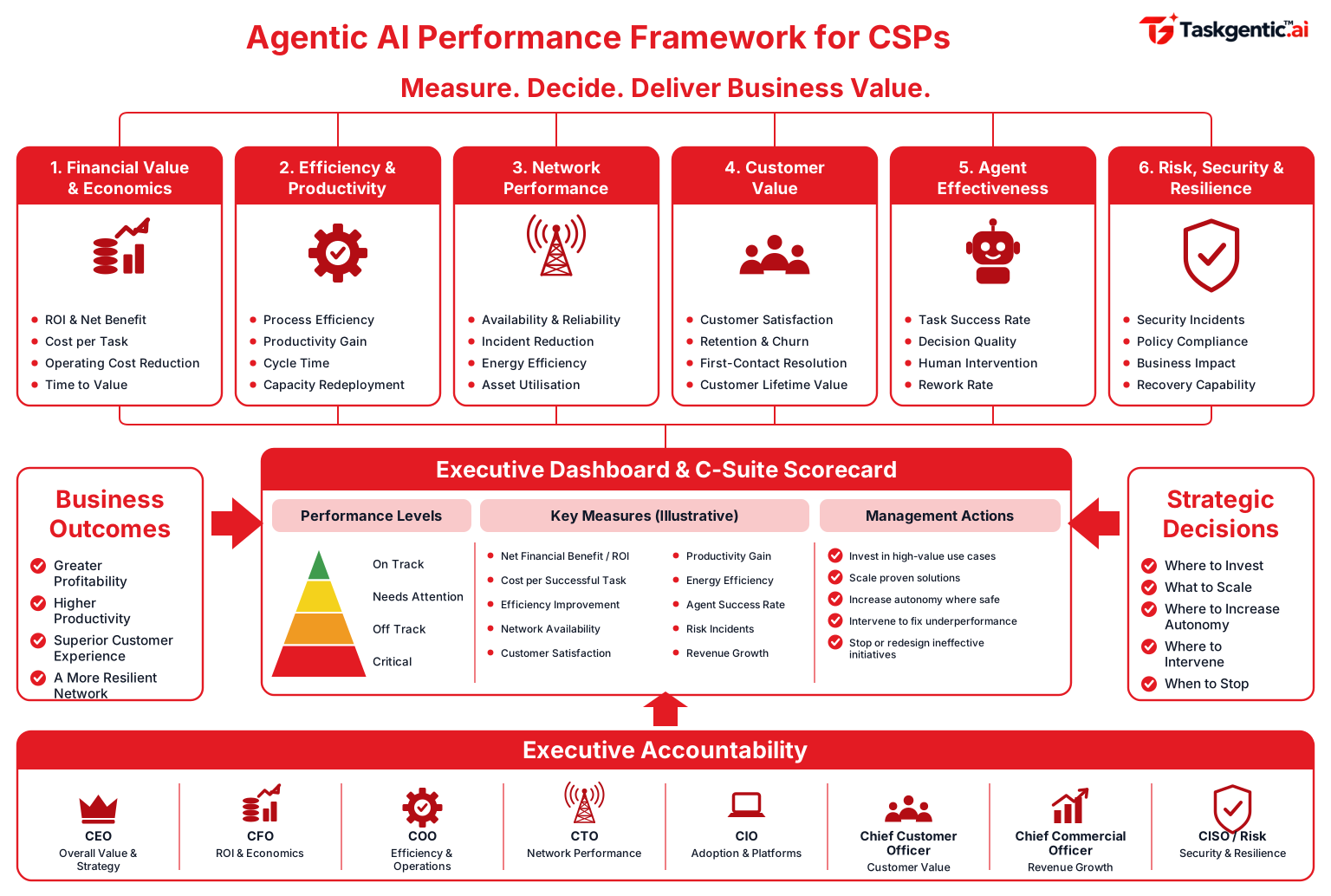 (opens the full-size diagram in a new tab)
1. What should CSP executives measure?
A useful executive framework should organise performance measures into three distinct levels.
Activity measures show what Agentic AI is doing. Examples include the number of agents deployed, the volume of tasks handled and the proportion of processes involving autonomous execution.
Performance measures show how effectively agents are operating. These include task success rates, decision quality, processing time, human intervention and the cost of completing tasks.
Business outcome measures show whether those activities and improvements are creating value for the CSP. Examples include operating expenditure reduction, improved network availability, lower energy consumption, increased customer retention and additional revenue.
These three levels should be connected. Activity demonstrates adoption, performance demonstrates effectiveness, and business outcomes demonstrate value.
For executive reporting, business outcomes should carry the greatest weight. Activity and performance indicators explain why business results are improving or deteriorating, but they should not be mistaken for success in their own right.
There is also an important distinction between an operational improvement and a financial return. Releasing employee capacity, for example, may improve productivity, but it does not automatically reduce expenditure. The financial benefit depends on whether that capacity is redeployed to higher-value work, supports additional business, or enables the organisation to reduce costs.
A credible framework should make these distinctions visible.
2. Six areas that should define executive performance
2.1 Financial value and the economics of Agentic AI
The first responsibility of the executive leadership team is to establish whether Agentic AI represents a sound financial investment.
CSPs should assess the complete economics of their agent deployments, including implementation, infrastructure, integration, model consumption, platform licences, monitoring, security, maintenance and human oversight.
The principal measures should include:
- Return on investment: Financial return generated relative to the total investment.
- Net financial benefit: Realised financial gains after deducting the full costs of operating Agentic AI.
- Operating expenditure reduction: Actual reductions in business and network operating costs attributable to agents.
- Cost per successful task: Total execution cost, including model usage, infrastructure, human intervention and rework, divided by successfully completed tasks.
- Cost per completed business process: End-to-end cost of delivering a process using Agentic AI, compared with the previous operating model.
- Cost of exceptions and rework: Additional expense created by unsuccessful tasks, incorrect actions, escalations and remediation.
- Time to value: Period between investment and the achievement of measurable financial benefits.
- Revenue contribution: Additional revenue generated through AI-enabled services, improved sales processes or commercial opportunities.
An important consideration is whether the economics improve as deployment scales. An agent may deliver attractive results in a limited pilot but become expensive when handling much larger volumes.
Executives should monitor how the cost per successful task changes as volumes increase, whether additional infrastructure or oversight is required, and whether the benefits grow faster than the costs.
This is particularly important where agents interact with multiple systems, use several AI models or require human intervention to complete complex processes.
The CFO should be able to distinguish between projected savings, costs avoided, productivity capacity released and actual financial benefits realised. These are not interchangeable.
The investment case should also identify whether savings are recurring, whether they depend on changes to the operating model and how long they are expected to last.
2.2 Enterprise efficiency, productivity and operating model improvement
Agentic AI has the potential to improve productivity across network operations, IT, customer service, finance, procurement and commercial functions.
For executives, the question is whether the organisation is achieving more with the resources it has, completing work more efficiently and reducing the complexity and cost of its operations.
The measures should include:
- Efficiency improvement: Reduction in the time, effort or resources required to complete business processes.
- Productivity improvement: Increase in output or service capacity achieved with existing resources.
- Process cycle time: Reduction in the time required to complete end-to-end activities.
- Manual workload reduction: Proportion of repetitive or administrative work removed from employees.
- Workforce capacity released: Employee time made available for higher-value activities.
- Capacity redeployment: Proportion of released capacity successfully used elsewhere in the business.
- Process cost reduction: Reduction in the total cost of delivering key business processes.
These measures need to reflect actual changes in the way the business operates.
For example, an agent may reduce the time required to process a customer request from several hours to a few minutes. That is an efficiency improvement. If the organisation can then process more requests with the same resources, it is also a productivity improvement.
However, the financial benefit only becomes clear when the CSP changes how resources are deployed, reduces costs or increases its service capacity.
This is why Agentic AI should be considered an opportunity to redesign operating models, rather than simply automate existing processes.
The COO should assess whether the organisation is achieving sustainable improvements across complete business processes, not just individual tasks.
2.3 Network economics, performance and resilience
For CSPs, network operations represent one of the most important opportunities for Agentic AI. Autonomous agents could identify network problems, assess conditions, coordinate corrective actions and increasingly manage routine operational decisions.
However, network autonomy should not be measured simply by the proportion of tasks performed without human involvement. Executives need to understand whether it is improving the performance and economics of the network.
The relevant measures should include:
- Network availability: Improvement in the availability and reliability of network services.
- Service disruption reduction: Reduction in the frequency, duration and impact of network incidents.
- Mean time to repair: Improvement in the time required to restore services following faults.
- Autonomous incident resolution: Proportion of eligible network incidents successfully resolved without human intervention.
- Network asset utilisation: Improvement in the productive use of existing network capacity and infrastructure.
- Energy consumption and efficiency: Reduction in energy use and energy cost relative to network traffic, capacity or service delivered.
- Network operating expenditure: Reduction in maintenance, field operations, fault management and other network operating costs.
- Capital efficiency: Improvement in the utilisation and productive life of existing assets, potentially reducing or deferring capital investment.
- Operational resilience: Ability to maintain or restore critical services when network conditions or supporting systems fail.
These indicators provide a more complete view of the contribution Agentic AI can make to network operations.
For example, an agent that optimises network resources may improve capacity utilisation and reduce energy consumption without requiring additional infrastructure. An agent that predicts and resolves faults may reduce field engineering costs and prevent service interruptions.
The commercial significance is the combined impact on network quality, operating expenditure, energy consumption and capital efficiency.
The CTO and COO should therefore assess network autonomy in terms of the financial and operational benefits it creates, rather than treating autonomy as an objective in isolation.
2.4 Customer experience and commercial value
Agentic AI should improve the experience customers receive and contribute to the commercial performance of the CSP.
Agents could identify customer issues earlier, coordinate service resolutions across multiple systems, improve customer interactions and support more personalised products and services.
The executive measures should include:
- Customer satisfaction: Improvement in customer perceptions of service quality and experience.
- Customer retention and churn: Contribution of AI-enabled services and interactions to customer retention.
- First-contact resolution: Proportion of customer issues resolved without repeat contact.
- Customer effort: Reduction in the time and effort customers need to resolve problems.
- Cost to serve: Reduction in the cost of successfully serving customers.
- Customer lifetime value: Improvement in the long-term commercial value of customer relationships.
- Additional revenue: Revenue generated through AI-enabled products, services and commercial processes.
An important consideration is attribution. Customer satisfaction may improve for several reasons, so CSPs need to understand the contribution made by Agentic AI rather than assuming that every improvement is a result of its deployment.
The same applies to customer retention and revenue. The organisation should compare relevant customer groups, services and processes to establish whether AI-enabled improvements are creating a measurable difference.
The objective is to demonstrate that Agentic AI is not only reducing the cost of customer service but also strengthening customer relationships and supporting commercial growth.
2.5 Agent effectiveness, decision quality and autonomy
Executives need confidence that agents can perform their responsibilities reliably, particularly as they move from providing recommendations to making decisions and taking actions independently.
The measures should go beyond the number of tasks completed or the percentage of work performed autonomously.
They should include:
- Successful task completion: Proportion of assigned tasks that achieve the intended business outcome.
- Decision quality: Proportion of agent decisions assessed as correct and appropriate for the situation.
- Incorrect action rate: Frequency of incorrect, unintended or inappropriate actions.
- Human intervention rate: Proportion of tasks requiring human assistance or approval.
- Escalation effectiveness: Whether agents correctly identify situations that require human judgement.
- Rework and reversal rate: Frequency of completed actions that subsequently need correction or reversal.
- Agent failure impact: Financial, operational or customer consequences of unsuccessful agent activity.
CSPs should also distinguish between different levels of autonomy:
- AI-assisted: Agents provide information or recommendations, but people make the decisions and execute the actions.
- Human-approved execution: Agents prepare and initiate actions that require human approval.
- Supervised autonomy: Agents execute tasks independently within defined boundaries, with human oversight.
- Bounded autonomy: Agents make decisions and execute approved actions independently within established policies and limits.
This distinction matters because a high level of autonomous execution is not necessarily evidence of better performance. The quality of decisions, the frequency of errors and the business consequences of those actions are equally important.
The executive question is whether the organisation can safely increase autonomy while maintaining or improving business outcomes.
2.6 Enterprise risk, security and operational resilience
The ability of agents to access information, interact with systems and take actions introduces new forms of enterprise risk.
For CSPs, these risks extend beyond conventional cybersecurity. An agent could make an incorrect network change, expose sensitive customer information, initiate an unauthorised transaction or disrupt a critical business process.
The executive measures should include:
- Critical security incidents: Number and severity of incidents involving Agentic AI.
- Policy and compliance violations: Instances where agents act outside approved policies or regulatory requirements.
- Unauthorised actions: Actions taken beyond an agent’s permitted authority.
- Audit and accountability coverage: Proportion of material agent decisions and actions that can be traced to an accountable owner.
- Business impact of agent failures: Financial, operational and customer consequences arising from agent errors or service interruptions.
- Recovery capability: Ability to suspend, reverse or recover from inappropriate agent actions.
- Operational continuity: Ability to maintain critical services when agents, AI models or supporting platforms become unavailable.
Executives should have assurance that agents operate within clearly defined boundaries and that the organisation can intervene when required.
For critical network and business functions, the ability to revert to human-controlled operations is particularly important.
The objective is to increase autonomy without weakening security, accountability or service continuity.
3. The executive dashboard: connecting performance to business value
The six areas can be consolidated into an executive dashboard that allows leadership to assess the overall contribution of Agentic AI.
The following measures provide a practical starting point.
| Executive priority | Key performance measures | What leadership needs to understand |
|---|---|---|
| Financial value | Net financial benefit, ROI, total cost of ownership | Are investments generating sustainable returns after all operating costs? |
| Agent economics | Cost per successful task, cost per completed process, exception and rework costs | Does the business case remain attractive as volumes increase? |
| Business efficiency | Process efficiency improvement, cycle time, process cost | Are business processes becoming faster and less resource-intensive? |
| Workforce productivity | Productivity improvement, capacity released and redeployed | Is the organisation achieving more with its existing workforce? |
| Network performance | Network availability, service disruption, incident restoration | Are networks becoming more reliable and resilient? |
| Network economics | Network operating expenditure, asset utilisation | Are networks becoming less expensive to operate and existing assets better utilised? |
| Energy and capital efficiency | Energy consumption relative to network output, capital efficiency | Are energy and infrastructure resources being used more effectively? |
| Customer value | Customer satisfaction, churn, first-contact resolution, cost to serve | Are customers receiving better service and remaining with the CSP? |
| Commercial growth | Additional revenue, customer lifetime value | Is Agentic AI contributing measurable commercial value? |
| Agent effectiveness | Successful task completion, decision quality, incorrect actions and rework | Are agents consistently delivering the intended outcomes? |
| Autonomy | Human intervention, escalation and reversal rates | Can agents take on greater responsibility without reducing quality or control? |
| Risk and resilience | Critical incidents, policy violations, business impact and recovery | Can the CSP scale autonomy without creating unacceptable exposure? |
Each measure should have an agreed baseline, target, reporting frequency and accountable executive owner. Targets should be set against the CSP’s own operating baseline, business case and strategic objectives, rather than assuming that a single industry benchmark will apply to every operator or use case.
Results should be segmented by use case and business function. This prevents strong performance in one area from concealing poor results elsewhere.
The dashboard should also distinguish between leading and lagging indicators. Autonomous task completion, for example, is an indicator of adoption and operational progress. Reduced operating expenditure, improved network availability and better customer retention are evidence of business outcomes.
Both are useful, but they answer different questions.
4. A one-page C-suite scorecard
The executive dashboard provides a broad view of performance. A concise scorecard turns that information into a practical leadership tool.
It should be reviewed regularly by the executive team, with a more comprehensive assessment presented to the Board at agreed intervals.
| Strategic dimension | Core KPI | Executive test |
|---|---|---|
| Financial value | Net financial benefit and ROI | Are realised benefits exceeding the full cost of investment and operation? |
| Agent economics | Cost per successful task | Is the agent more economical than the existing process, including human intervention and rework? |
| Business efficiency | Efficiency improvement | Are processes measurably faster and less resource-intensive? |
| Workforce productivity | Productivity improvement | Is released capacity being used productively or translated into lower costs? |
| Network performance | Availability and incident restoration | Are service reliability and recovery improving? |
| Network economics | Network operating cost and asset utilisation | Are operating costs falling and infrastructure being used more effectively? |
| Energy and capital efficiency | Energy intensity and capital efficiency | Are energy and network assets delivering more value? |
| Customer value | Satisfaction and churn | Are customer experience and retention improving? |
| Commercial growth | Incremental revenue and customer lifetime value | Is Agentic AI creating demonstrable commercial value? |
| Agent effectiveness | Successful task completion and decision quality | Are agents achieving the intended outcomes consistently? |
| Autonomy | Human intervention and escalation rate | Is autonomy increasing without deterioration in quality or control? |
| Risk and resilience | Critical incidents and policy violations | Are risks controlled and recovery arrangements effective? |
Scorecard status and management response
Every KPI should have an agreed target and a clear status. A simple four-level approach makes the results easier to interpret and act upon.
| Status | Meaning | Expected executive response |
|---|---|---|
| On track | Meets or exceeds the agreed target | Maintain performance and consider further investment or scale. |
| Needs attention | Below target or showing an adverse trend | Identify the cause, agree corrective action and monitor progress. |
| Off track | Materially below target or business case | Review the investment, operating model, scope or level of autonomy. |
| Critical | Unacceptable financial, operational, security or compliance exposure | Intervene immediately; restrict, suspend or revert autonomy where necessary. |
The scorecard should not be reduced to a collection of red, amber and green indicators. Each status needs an explanation, an accountable owner and an agreed action. A measure can be on track while still requiring attention if the underlying trend threatens future performance.
Five questions for the executive committee
The scorecard should enable the leadership team to answer five questions:
- Value: Are we realising financial benefits after accounting for the full cost of operating Agentic AI?
- Efficiency: Are we improving productivity and making better use of workforce and operational resources?
- Network: Are we improving reliability, energy efficiency, asset utilisation and network economics?
- Scale: Which use cases have demonstrated sufficient value and reliability to justify wider deployment or greater autonomy?
- Control: Are security, compliance, accountability and operational recovery arrangements adequate for the level of autonomy being deployed?
If these questions cannot be answered with credible evidence, the organisation does not yet have a sufficient basis for scaling its investment.
5. Turning performance measures into executive decisions
A performance framework is valuable only if it informs management action. The purpose of the executive dashboard and scorecard should therefore be to guide decisions about investment, deployment, autonomy and risk.
Five decisions should be central to the leadership review.
Invest: Where should we allocate more capital?
Investment should be directed towards use cases with a clear business problem, measurable potential benefits and a credible path to financial return.
Executives should compare expected benefits, implementation costs, operating costs, delivery risks and time to value across different opportunities.
A use case that demonstrates strong productivity improvements, lower cost per successful task and measurable customer or network benefits may justify further investment.
Scale: Where is Agentic AI ready for wider deployment?
Successful pilots should not automatically lead to enterprise-wide deployment.
Before scaling, CSPs should establish that performance is repeatable, economics remain attractive at higher volumes, integration is sustainable and risks are controlled.
The cost per successful task should be monitored as volumes increase. If additional infrastructure, model usage or human intervention causes costs to rise disproportionately, the business case may weaken.
Scaling should also depend on evidence that agents can maintain decision quality and service outcomes under more demanding operating conditions.
Increase autonomy: Where can agents take on greater responsibility?
Greater autonomy should be earned through demonstrated performance, not treated as an automatic next step.
Executives should look for consistent decision quality, low levels of incorrect action and rework, effective escalation and reliable recovery arrangements.
Where these conditions are met, the organisation may consider widening the range of decisions and actions agents can take independently. Where they are not, existing levels of human approval and supervision should remain in place.
Intervene: Where is performance falling short?
Where agents are not meeting their targets, executives should understand the underlying reasons.
Poor results may be caused by inadequate integration, weak data quality, excessive human intervention, unreliable decisions or processes that are unsuitable for autonomous execution.
The appropriate response may be to improve the technology, redesign the process, adjust the agent’s authority or strengthen human oversight.
The objective is to correct the underlying problem rather than continue deploying technology that is not delivering the expected value.
Stop or redesign: Where is the business case no longer justified?
Not every Agentic AI initiative will succeed.
If a use case consistently fails to deliver financial benefits, has an uneconomic cost per successful task, creates unacceptable risk or performs no better than the existing process, executives should be prepared to stop or redesign it.
This is an important part of investment discipline. The success of an Agentic AI strategy should not be measured by how many initiatives remain active, but by how effectively capital and resources are directed towards those that create value.
6. Executive accountability
Agentic AI performance should be managed as an enterprise responsibility rather than a technology programme.
Clear accountability ensures that the measures lead to business decisions rather than becoming another reporting exercise.
| Executive role | Primary accountability |
|---|---|
| CEO | Strategic contribution, enterprise priorities and overall business value. |
| CFO | ROI, realised financial benefits, total cost of ownership and unit economics. |
| COO | Operational efficiency, productivity, process performance and operating model improvement. |
| CTO | Network performance, network autonomy, resilience, energy and capital efficiency. |
| CIO | Enterprise adoption, integration and the economics of supporting platforms and systems. |
| Chief Customer Officer | Customer satisfaction, retention, customer effort and cost to serve. |
| Chief Commercial Officer | Incremental revenue, customer lifetime value and commercial contribution. |
| CISO and risk leadership | Security, compliance, accountability, operational risk and resilience. |
The CEO should own the strategic contribution and ensure that investment supports the organisation’s priorities. The CFO should validate financial returns and the economics of scaling. The COO should oversee productivity, efficiency and operating model improvements.
The CTO and CIO should ensure that network and enterprise capabilities deliver the expected business value. Customer and commercial leadership should own customer experience, retention and revenue outcomes. The CISO and risk leadership should ensure that security, compliance and accountability remain effective as autonomy increases.
These responsibilities should be supported by a common performance framework, agreed definitions and consistent reporting.
Individual executives do not need to monitor every indicator, but the leadership team should share a clear understanding of the organisation’s overall performance, the benefits being realised and the decisions required.
7. The role of standards and interoperability
Standards matter to the executive agenda because they influence investment protection, supplier choice and the ability to scale Agentic AI across complex telecommunications environments.
Initiatives from organisations such as ITU-T, TM Forum, ETSI and GSMA contribute to common approaches for autonomous networks, intelligent network management and standardised API exposure.
For CSP leaders, the key consideration is whether the technology environment supports interoperability and avoids unnecessary dependence on individual suppliers.
A fragmented architecture can increase integration costs, restrict innovation and make it harder to change technology providers. These issues can ultimately affect the economics of Agentic AI.
Interoperability and standards alignment should therefore form part of investment appraisal and supplier governance, rather than become a separate set of technical measures on the main executive dashboard.
8. From deployment to measurable business value
Agentic AI presents a significant opportunity for telecommunications operators, but its success will not be determined by the number of agents deployed or the level of autonomy achieved.
It will be determined by whether CSPs can demonstrate sustainable improvements in financial performance, operating efficiency, workforce productivity, network economics, customer value and operational resilience.
That requires executives to look beyond activity measures and focus on the outcomes that matter to the business. It also requires a clear understanding of the economics of operating agents, particularly as deployments move from pilots into large-scale production.
The executive scorecard provides a practical way to keep those outcomes in view. It connects financial returns, operating performance, customer outcomes and risk to the decisions that matter: where to invest, what to scale, when to increase autonomy, where to intervene and when to stop.
The measures should be reviewed against agreed CSP baselines and targets, with clear ownership and evidence of realised benefits. This will help ensure that Agentic AI investment remains commercially disciplined as adoption grows.
Agentic AI should be measured as a business capability, not a technology deployment. For CSPs, its success will ultimately be judged by whether it improves the economics of the business, makes better use of network and workforce resources, strengthens customer relationships and creates a more competitive and resilient organisation.
About the Author
Chief AI Officer at Taskgentic.ai. Leading the development of enterprise agent architectures that combine collective intelligence, modular workflows and rigorous security guardrails for complex operational environments.
About Taskgentic.ai
Taskgentic.ai is developing the next generation of AI-driven task intelligence, helping Communications Service Providers move from isolated AI agents to secure, reusable and governed ensembles and assemblies that deliver measurable business outcomes.