

CSPs must retain strategic control of the agent ecosystem rather than become integrators of competing vendor platforms.
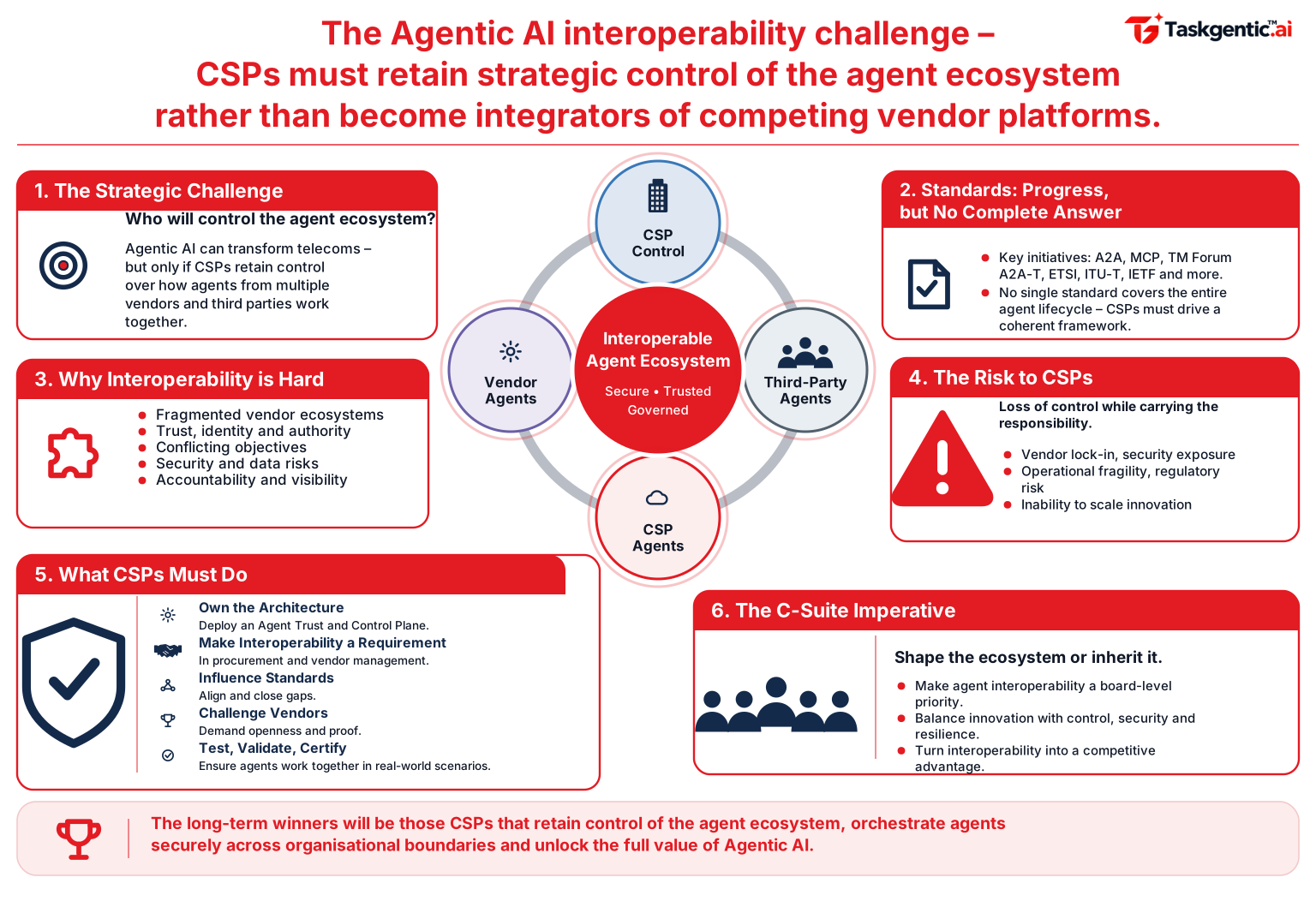
1. The strategic challenge: Who will control the agent ecosystem?
Agentic AI has the potential to transform how Communications Service Providers (CSPs) operate, manage networks and deliver services. Its greatest value, however, will not come from individual agents performing isolated tasks. It will come from agents working together across network domains, operational systems, suppliers and service environments.
That creates a significant strategic challenge. Major technology vendors and hyperscalers are developing their own agent platforms, frameworks and ecosystems. Each is seeking to establish its technology as the preferred environment for building, deploying and managing agents.
For CSPs operating complex, multi-vendor environments, this presents a difficult choice. They can allow competing vendor ecosystems to develop around their operations, potentially becoming responsible for integrating platforms they do not control. Alternatively, they can establish the architectural principles and governance needed to retain control over how agents interact, collaborate and exercise authority.
The distinction is important. CSPs could end up carrying the complexity, integration costs, operational exposure and accountability of an agent ecosystem while vendors retain control of the underlying platforms and commercial relationships.
Interoperability must therefore be treated as a strategic design principle from the outset, rather than an integration problem to be resolved after individual agent solutions have been deployed.
 (opens the full-size diagram in a new tab)
2. The standards landscape: Connectivity is not the same as interoperability
The standards landscape is developing rapidly. Open protocols such as MCP (Model Context Protocol) and A2A (Agent2Agent) are making it easier for agents to access tools and services, discover other agents and collaborate across different platforms. In telecommunications, initiatives such as TM Forum’s A2A-T are extending these capabilities to address the requirements of multi-vendor and autonomous network environments. Work across ETSI, ITU-T, IETF and other industry bodies is also contributing to the wider framework.
This is important progress. It would be wrong to suggest that the industry lacks standardised interfaces or mechanisms for agent communication. However, standardised interfaces do not, by themselves, guarantee that agents from different suppliers can work together reliably in complex operational environments.
An agent may be able to discover another agent, exchange information and request an action without necessarily understanding the operational context, interpreting the same network intent or following the same policies. Nor does protocol compliance automatically establish consistent identity, trust, delegated authority, security or accountability.
For CSPs, the challenge is moving beyond connectivity towards genuine interoperability: ensuring that agents can collaborate safely and predictably across network domains, operational systems and organisational boundaries, while remaining subject to the operator’s policies and control.
This distinction should shape the industry’s approach to standards. CSPs need to participate actively in their development, but they must also define the architectural, operational and commercial requirements that standards alone cannot guarantee.
3. Why interoperability is more than connecting agents
The real test of interoperability is not whether two agents can communicate. It is whether they can work together to achieve an operational outcome without introducing conflict, risk or unintended consequences.
Telecoms provides a particularly demanding environment. Network operations span multiple technologies, suppliers, domains and management systems. An agent supporting network optimisation may need to coordinate with agents responsible for fault management, service assurance, capacity planning and customer experience. Each may have different objectives, data sources, decision processes and levels of authority.
Several challenges follow.
Different platforms and operating models. Vendors will develop agents using different architectures, models, tools and orchestration frameworks. Supporting common protocols is a useful starting point, but it does not ensure consistent behaviour or seamless collaboration across platforms.
Shared understanding of operational intent. Agents must interpret network information, service states, alarms, policies and operational instructions consistently. A fault-management agent and a service assurance agent, for example, need a common understanding of the fault, its impact on customers and the priorities for resolution. Exchanging data is not enough if the meaning is interpreted differently.
Coordination of actions and responsibilities. Agents need to understand task ownership, dependencies, priorities and the consequences of their decisions. A network optimisation agent must not initiate an action that conflicts with a maintenance activity or compromises a service assurance objective. Conflicting recommendations and competing objectives need to be resolved within clearly defined operational policies.
Identity, trust and delegated authority. CSPs must know which agents are participating, who operates them, what they are authorised to access and which actions they are permitted to perform. An agent’s ability to request an action should never be confused with the authority to execute it.
Security and data protection. Every additional agent, interface and connection creates potential exposure. Data access, information sharing, tool permissions and dependencies on external models or services need to be controlled across the ecosystem.
Visibility and accountability. CSPs need to understand what agents have done, why they acted, what information informed their decisions and what happened as a result. This becomes particularly important when several agents from different suppliers contribute to the same operational outcome.
These challenges make interoperability an operational issue as much as a technical one. The objective is not simply to make agents communicate, but to ensure that their combined behaviour remains consistent with the CSP’s operational priorities, security requirements and service commitments.
4. The risk to CSPs: Losing control while carrying the responsibility
The commercial and operational implications of fragmented agent ecosystems should not be underestimated. If every major supplier brings its own agent platform, control framework and integration requirements, CSPs could find themselves managing an increasingly complex environment with limited influence over its underlying design.
The principal risks include:
| Risk | Potential consequence for CSPs | What needs to be addressed |
|---|---|---|
| Vendor ecosystem dependency | Lock-in, rising integration costs and restricted choice | Open interfaces, portability and procurement requirements |
| Weak agent identity and trust | Unauthorised access or actions | Identity, authentication, permissions and delegated authority |
| Inconsistent agent behaviour | Conflicting actions and service degradation | Clear autonomy boundaries, policies and approval mechanisms |
| Security and supply-chain exposure | Compromised systems, data or network operations | Supplier assurance, monitoring and isolation |
| Data governance failures | Privacy, intellectual property and regulatory exposure | Control over data access, use, sharing and residency |
| Insufficient accountability | Difficult investigations, supplier disputes and unclear responsibility | Traceable decisions, audit evidence and contractual obligations |
| Operational fragility | Cascading failures and disruption across dependent systems | Resilience, recovery, fallback and escalation arrangements |
| Inadequate interoperability assurance | Failed deployments and inability to scale | Independent multi-vendor testing and continuous validation |
There is also a question of commercial accountability that deserves particular attention. In a multi-vendor ecosystem, one supplier’s agent may trigger an action that affects another supplier’s system or a CSP-managed service. When something goes wrong, responsibility can become difficult to establish.
CSPs must not be left to resolve these disputes while carrying the operational and customer consequences. Contracts need to make clear who is responsible for agent decisions and actions, what evidence suppliers must provide, how incidents will be investigated and how remediation will be handled. Suppliers should also be required to disclose material changes to agent capabilities or behaviour that could affect interoperability or operational risk.
These controls should apply equally to internally developed agents. An agent does not become inherently trustworthy simply because it has been developed by the CSP. The same expectations for identity, authority, policy compliance, monitoring and accountability must apply across the entire ecosystem.
Ultimately, CSPs cannot outsource responsibility for the integrity of their operating environment. They need sufficient control and visibility to manage the risks created by every agent participating in it.
5. What CSPs must do to retain strategic control
CSPs need to move beyond individual agent deployments and establish a coherent approach to the architecture, governance and commercial management of the wider ecosystem.
Own the architecture and control framework
The CSP should determine how agents are registered, identified, authenticated and authorised, irrespective of who supplies them. A CSP-controlled Agent Trust and Control Plane could provide the foundation for this approach, covering agent identity, provenance, permissions, delegation, policy enforcement, data access, monitoring, audit and lifecycle management.
This does not mean that CSPs need to build every agent or replace vendor platforms. It means that suppliers should operate within an architectural and governance framework established by the operator.
Make interoperability a procurement requirement
Open protocols should be a baseline expectation, not a differentiator in vendor presentations. Procurement requirements should cover cross-vendor interoperability, portability, transparency, independent testing and visibility of changes to models, software and agent capabilities.
Suppliers should demonstrate that their agents can operate beyond their own proprietary platforms and collaborate with agents from other vendors in realistic telecom scenarios. CSPs should also retain the ability to replace components without having to redesign the wider ecosystem.
Establish independent interoperability assurance
Vendor demonstrations are not sufficient evidence that an agent ecosystem will work in live operations. CSPs need independent testing across different suppliers, platforms and network domains.
Testing should examine more than successful message exchange. It should establish whether agents understand shared operational context, coordinate tasks correctly, respect authority boundaries and respond appropriately when instructions conflict or conditions change.
Failure scenarios are particularly important. What happens when an agent becomes unavailable, provides incorrect information, acts outside its intended scope or is updated by its supplier? Can the CSP identify the cause, contain the impact and restore normal operations without depending entirely on the vendor?
Independent conformance testing and ongoing validation should become part of the deployment and lifecycle process, rather than a one-off exercise before launch.
Influence the standards agenda
CSPs should remain actively involved in the work of TM Forum, ETSI, ITU-T, IETF, 3GPP, GSMA and other relevant industry bodies. The focus should be on practical requirements for identity, trust, delegation, semantics, policy, interoperability testing and accountability.
The objective should be to encourage consistency across initiatives and prevent the emergence of competing approaches that simply reinforce individual vendor ecosystems.
Challenge vendors and hyperscalers on openness
Supporting open standards is a starting point, not proof of genuine interoperability. CSPs should challenge suppliers to demonstrate that their platforms can work with competing technologies without imposing proprietary dependencies or retaining exclusive control over orchestration, governance and agent lifecycle management.
The industry needs to distinguish between vendors that genuinely enable an open agent ecosystem and those that use open interfaces to extend the reach of otherwise closed platforms.
6. The C-suite imperative: Shape the ecosystem or inherit it
Agentic AI interoperability should not be treated as a narrow technology or integration issue. It has direct implications for CSP operating models, supplier relationships, investment decisions, security, resilience and long-term strategic independence.
The decisions being made today will influence who controls the agent ecosystem, who sets the rules for collaboration and who carries the consequences when something goes wrong.
C-suite leaders need to make interoperability a priority across architecture, procurement, investment, partnerships and risk governance. They should ensure that open interfaces, independent assurance, clear commercial accountability and CSP-controlled governance are built into the agent strategy from the beginning.
The objective is not to limit innovation or prevent vendors from developing differentiated capabilities. It is to ensure that CSPs can benefit from innovation across the supplier landscape without surrendering control of the environment in which those capabilities operate.
MCP, A2A and other standards provide an increasingly important foundation for agent connectivity. The next challenge is to turn that connectivity into a trusted, resilient and commercially sustainable multi-vendor ecosystem.
The long-term winners will not necessarily be the CSPs with the largest number of agents or the most extensive vendor partnerships. They will be those that retain control over how agents collaborate, govern the authority they exercise and hold suppliers accountable for their contribution.
CSPs should shape the agent ecosystem, not become integrators of competing vendor platforms.
About the Author
Chief AI Officer at Taskgentic.ai. Leading the development of enterprise agent architectures that combine collective intelligence, modular workflows and rigorous security guardrails for complex operational environments.
About Taskgentic.ai
Taskgentic.ai is developing the next generation of AI-driven task intelligence, helping Communications Service Providers move from isolated AI agents to secure, reusable and governed ensembles and assemblies that deliver measurable business outcomes.