

The next competitive frontier in telecommunications
For decades, Communications Service Providers (CSPs) have competed on the strength of their networks: coverage, capacity, speed, reliability and cost. These remain essential foundations of the telecommunications business. But as connectivity becomes increasingly ubiquitous, commoditised and difficult to differentiate, a new question is emerging: What will make one network more valuable than another?
The answer increasingly lies in intelligence.
The telecommunications industry is approaching a fundamental inflection point. The convergence of 5G, cloud-native infrastructure, edge computing, software-defined networks and Artificial Intelligence (AI) is creating the opportunity to transform networks from infrastructure that delivers connectivity into intelligent platforms that understand, adapt and optimise connectivity in real time.
This is more than another technology upgrade. It represents a shift in the economics, operating model and competitive positioning of CSPs.
Tomorrow’s leading CSPs will not simply own and operate better networks. They will operate networks that understand their environment, anticipate demand, make decisions and take controlled action to deliver the best possible outcomes for customers and the business.
Intelligence will become as strategically important to telecommunications as connectivity itself.
However, achieving this transformation requires a fundamental change in how CSPs approach AI. The opportunity is not to introduce AI applications into existing network architectures. It is to embed intelligence throughout the architecture, from strategic reasoning and domain-specific decisions to operational execution and real-time network control.
The principle is simple: intelligent connectivity requires intelligence at every layer.
1. The strategic shift: From selling connectivity to delivering intelligent outcomes
Historically, CSPs have invested in network capabilities and then built services on top of them. Network performance, capacity and availability have largely defined the value proposition.
That model is becoming insufficient.
Enterprise customers increasingly expect connectivity to support business outcomes rather than simply provide bandwidth. They want predictable application performance, guaranteed service levels, security, resilience, flexibility and the ability to adapt resources dynamically as business requirements change.
For example, an industrial enterprise does not necessarily want a faster private 5G network. It wants uninterrupted production, predictable machine communication, optimised operations and minimal downtime.
Similarly, a financial services organisation wants secure, resilient and responsive connectivity that supports critical business applications. A logistics provider wants its connectivity to adapt to changing operational conditions, locations and demand.
These expectations require networks to understand context, not just transport traffic.
This is where intelligent connectivity becomes strategically important. It enables CSPs to move from providing connectivity as a relatively standardised product towards delivering adaptive, context-aware and outcome-oriented services.
The implications extend across the business:
- Revenue growth: Differentiated, application-aware and performance-oriented connectivity services.
- Margin improvement: Lower operating costs through predictive maintenance, automation and resource optimisation.
- Capital efficiency: Better utilisation of existing infrastructure through intelligent capacity management and investment prioritisation.
- Customer differentiation: More responsive, reliable and personalised services.
- Competitive positioning: Greater control over the intelligence layer that differentiates the CSP’s network and service portfolio.
AI therefore needs to be considered a strategic business capability, not simply an IT or network automation investment.
2. Why intelligence must exist at every layer
A common mistake in the current AI conversation is to focus too heavily on the model itself.
The arrival of increasingly powerful Large Language Models (LLMs) has created considerable enthusiasm. However, a general-purpose model alone cannot operate a telecommunications network. It does not inherently possess the detailed knowledge of every network domain, access to current operational conditions, authority to execute network changes or the deterministic behaviour required for critical infrastructure.
The real opportunity lies in combining different forms of intelligence, each performing a distinct role.
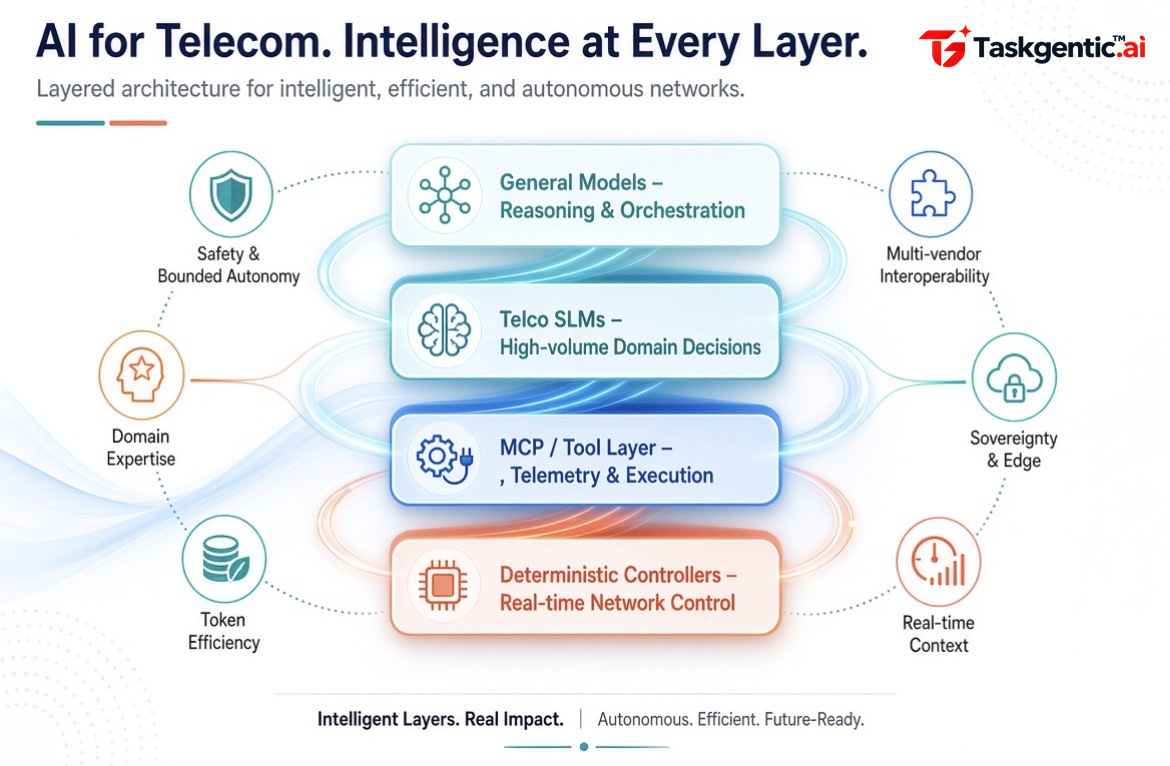
The architecture illustrated in AI for Telecom. Intelligence at Every Layer provides a blueprint for this approach.
It consists of four interconnected layers, supported by six essential architectural principles.
 (opens the full-size image in a new tab)
Layer 1: General Models – Strategic Reasoning and Orchestration
At the top of the architecture are general-purpose AI models.
Their role extends beyond answering questions or generating content. They provide the reasoning, planning and orchestration capabilities needed to translate business objectives into coordinated operational activities.
Imagine an enterprise customer requesting guaranteed connectivity performance across multiple locations. Meeting this requirement may involve several network domains, different technology vendors, edge resources, service policies and commercial commitments.
A general AI model can interpret the business requirement, break it down into operational objectives, coordinate specialised models and agents, and orchestrate the necessary workflows.
For CSPs, this layer provides an opportunity to connect previously fragmented operational and business intelligence.
Its strategic importance lies in enabling cross-domain decision-making. Rather than optimising individual network components in isolation, the CSP can increasingly manage the network around an overarching business or customer objective.
Layer 2: Telco Small Language Models – Intelligence That Understands the Network
General reasoning needs to be complemented by telecommunications expertise.
This is the role of Telco Small Language Models (SLMs).
Telecommunications networks generate highly specialised information: signalling data, network configurations, alarms, performance indicators, topology, service dependencies and operational policies.
General-purpose models are not necessarily optimised to interpret this information accurately or efficiently.
Telco SLMs bring specialised knowledge closer to the network domains where decisions need to be made.
They can support fault correlation, root-cause analysis, radio optimisation, service assurance, capacity management and other high-volume operational decisions.
The advantage is not simply that these models are smaller or cheaper. It is that they can be designed and adapted for specific telecommunications tasks, enabling more relevant, efficient and scalable intelligence.
For CSPs, this introduces a new strategic asset: the ability to develop and retain proprietary network intelligence built around their infrastructure, operational experience, data and domain expertise.
This is important for competitive differentiation. While access to general-purpose AI models may become increasingly widespread, a CSP’s ability to combine AI with its unique network knowledge and operational context can become a meaningful source of advantage.
Layer 3: MCP and Tool Integration – Connecting Intelligence to the Business of Running Networks
Intelligence without access to the real operating environment remains largely theoretical.
The third layer connects AI models and agents to the systems, data and capabilities required to understand and interact with the network.
Through the Model Context Protocol (MCP), APIs and other standardised integration mechanisms, AI applications can access relevant telemetry, query operational platforms and invoke approved tools.
This includes connectivity to OSS/BSS, network management, orchestration, service assurance, inventory, configuration management and real-time observability systems.
The significance of this layer is that it bridges the gap between knowing what should happen and being able to make it happen.
For example, an AI agent identifying network congestion needs more than the ability to recommend optimisation. It needs access to current utilisation data, network topology, available resources and the operational tools that can initiate a corrective workflow.
This layer enables that interaction.
For executive management, it highlights an important investment priority: the value of AI will depend significantly on how effectively it is connected to the CSP’s existing operational ecosystem.
Disconnected AI pilots may demonstrate impressive capabilities, but integrated intelligence creates sustainable business value.
Layer 4: Deterministic Controllers – Keeping Intelligence Safe and Networks Reliable
At the foundation of the architecture are deterministic controllers responsible for real-time network control and execution.
This is where the specific requirements of telecommunications become particularly important.
Networks are critical infrastructure. They must deliver predictable performance, availability, resilience and security. Their operation cannot depend entirely on probabilistic model outputs.
AI can reason, analyse, predict and recommend, but network actions must remain subject to defined policies, validation, constraints and execution controls.
Deterministic controllers provide this foundation.
They enforce operational policies, validate proposed changes, manage network parameters, execute approved actions and ensure that the network remains within acceptable operating conditions.
Consider an AI system identifying an opportunity to optimise radio resources or adjust network configurations to improve service performance. The AI may propose the action, but the appropriate controller must validate and execute it within established operational boundaries.
This creates a crucial separation of responsibilities: AI provides intelligence; deterministic control provides operational assurance.
For CSP leaders, this distinction is fundamental.
The objective is not to replace established network control mechanisms with AI. It is to make those mechanisms more intelligent, adaptive and responsive.
Autonomy without control creates risk. Control without intelligence limits opportunity. The future requires both.
3. Six principles that make intelligence enterprise-ready
The four layers describe where intelligence operates. Six complementary principles determine whether the architecture can be deployed successfully at telecommunications scale.
Safety and bounded autonomy
CSPs must define the boundaries within which AI can operate. Different activities require different levels of autonomy, from recommendations and human-approved actions to fully automated execution for well-defined, low-risk scenarios.
Governance, permissions, auditability, human oversight and fail-safe mechanisms must be embedded into the architecture.
The strategic objective is to increase autonomy without compromising accountability or network reliability.
Domain expertise
Telecommunications intelligence must understand telecommunications.
Network protocols, service dependencies, operational procedures, technology-specific behaviour and business requirements must inform AI decisions.
CSPs should treat their domain knowledge, operational data and accumulated network experience as strategic assets that can differentiate their AI capabilities.
Token and computational efficiency
AI must be economically viable at the scale of telecommunications operations.
Processing every network event through a large model is neither necessary nor commercially sustainable.
A combination of specialised SLMs, intelligent model routing, context filtering and larger reasoning models can optimise cost, latency and computational requirements.
The principle is to deploy the appropriate level of intelligence for each decision.
Multi-vendor interoperability
CSP networks are heterogeneous environments. Their intelligence architecture must work across vendors, technologies and network domains.
Open interfaces, standardised integration and common information models are essential to avoid creating another generation of technology silos.
Interoperability also protects CSP strategic independence and reduces long-term vendor dependency.
Sovereignty and edge intelligence
Data sovereignty, security and regulatory compliance are becoming increasingly important as AI becomes embedded in critical infrastructure.
CSPs need control over where models operate, where data is processed and where decisions are executed.
Edge deployment offers an additional advantage by bringing intelligence closer to network resources, reducing latency and enabling local decision-making.
Real-time context
Intelligence is only as useful as its understanding of current conditions.
Live telemetry, traffic patterns, service performance, network topology, resource availability and customer experience must inform decisions.
The ability to combine real-time operational context with historical knowledge and predictive insights is what allows a network to move from reactive operations towards proactive adaptation.
Together, these six principles make intelligence scalable, economically viable, interoperable and trustworthy.
4. The business opportunity: What intelligent connectivity changes
The business case for this transformation should not be confined to reducing network operating expenditure.
Operational efficiency is an important starting point, but the larger opportunity is to change how CSPs create and capture value.
- Intelligent networks can improve the economics of infrastructure. Predictive fault management, automated optimisation, energy-aware operations and intelligent capacity allocation can improve asset utilisation and reduce the cost of operating increasingly complex networks. This is particularly important as CSPs face continued pressure to improve returns on substantial infrastructure investments.
- Intelligence can enable differentiated enterprise services. Application-aware connectivity, adaptive network slicing, intelligent edge services and performance-based connectivity offerings can help CSPs move beyond standardised bandwidth products. The network becomes more responsive to the needs of specific industries, applications and business processes.
- Intelligence can improve customer experience and retention. By identifying service degradation before customers experience it, correlating network conditions with customer impact and proactively resolving problems, CSPs can improve service quality and strengthen customer relationships.
- Intelligence can create new opportunities for ecosystem partnerships. CSPs can combine connectivity, edge computing, security, cloud and AI capabilities to support enterprise digital transformation. Their infrastructure can become an intelligent platform for industrial automation, connected mobility, smart infrastructure and other emerging digital ecosystems.
The broader opportunity is to evolve from selling connectivity to enabling intelligent business outcomes.
5. The leadership challenge: Treat AI as a strategic operating-model transformation
For C-level management, the most important question is not which AI model to deploy or which network domain to automate first.
It is how to position the CSP for a future in which intelligence becomes an integral part of the network operating model and the customer value proposition.
This requires decisions at several strategic levels.
- Establish an enterprise-wide intelligence architecture. Avoid fragmented investments in isolated AI applications. Establish a common architectural direction that connects general models, specialised domain intelligence, operational tools and deterministic control.
- Build intelligence as a CSP capability. Develop the skills, data foundations, models and operational knowledge needed to retain control of the intelligence layer. Technology partnerships will remain important, but the strategic intelligence of the network should not become entirely dependent on external providers.
- Connect AI investments to business outcomes. Prioritise use cases based on measurable improvements in network economics, customer experience, capital efficiency, resilience and revenue potential.
- Make autonomy a progressive journey. Introduce autonomy incrementally, beginning with well-defined and lower-risk activities. Establish governance and assurance mechanisms before expanding towards more complex cross-domain decisions.
- Align network, IT and business leadership. Intelligent connectivity cuts across traditional organisational boundaries. Network operations, IT, enterprise services, customer experience, security and commercial teams must work towards shared objectives.
Ultimately, intelligent connectivity cannot be delivered by the network organisation alone. It requires an enterprise-wide commitment.
6. The destination: From autonomous networks to intelligent connectivity
The evolution towards autonomous networks is often discussed in terms of reducing human intervention in network operations.
While this is important, it is not the ultimate destination.
A truly intelligent network should continuously understand its environment, anticipate demand, optimise resources and adapt to changing conditions in pursuit of business and customer outcomes.
It should be capable of coordinating decisions across network domains, balancing performance, cost, energy consumption, resilience and service commitments.
It should also provide the foundation for new services that are context-aware, application-driven and increasingly autonomous.
This is a much broader ambition than automating network tasks.
It represents the transition from a network that provides connectivity to a network that intelligently manages the value of connectivity.
Conclusion: Intelligence is the next strategic asset of telecommunications
CSPs have invested decades in building the infrastructure that connects the world. Their next strategic challenge is to make that infrastructure intelligent.
The competitive advantage of the future will not come solely from owning more spectrum, deploying more sites or increasing network capacity. It will increasingly come from how intelligently those assets are operated, how effectively they respond to customer needs and how rapidly they can adapt to changing business and network conditions.
The architecture of AI for Telecom illustrates the foundations of this transformation.
General models provide reasoning and orchestration. Telco SLMs deliver specialised domain intelligence. MCP and tool integration connect intelligence to operational reality. Deterministic controllers ensure that actions are safe, reliable and predictable.
Supported by sovereignty, interoperability, domain expertise, real-time context, efficiency and bounded autonomy, these layers create the foundation for intelligent and autonomous networks.
For CSP leadership, the strategic imperative is clear: AI should not simply make today’s networks more efficient. It should fundamentally change what networks can deliver and what CSPs can become.
The next generation of telecommunications leaders will be those who recognise that connectivity is the foundation, but intelligence is the differentiator.
Beyond connectivity lies intelligent connectivity. And that future starts with intelligence at every layer.
About the Author
Chief AI Officer at Taskgentic.ai. Leading the development of enterprise agent architectures that combine collective intelligence, modular workflows and rigorous security guardrails for complex operational environments.
About Taskgentic.ai
Taskgentic.ai is pioneering the next generation of AI-driven task intelligence—helping enterprises move from isolated AI agents to secure, reusable and governed ensembles and assemblies that deliver measurable business outcomes.