

Communications Service Providers (CSPs) are investing heavily in AI to transform network operations, customer experience, IT delivery and business processes. Yet the next competitive advantage will not come simply from deploying more AI agents. It will come from how effectively those agents are reused, coordinated, secured and scaled into enterprise-wide capabilities.
Two complementary architectural patterns are central to this opportunity: Agent Ensembles and Agent Assemblies. Together, they provide a foundation for moving beyond isolated AI pilots towards a reusable, governed and secure AI ecosystem.
 (opens the full-size diagram in a new tab)
Agent Ensembles: Collective Intelligence for Better Decisions
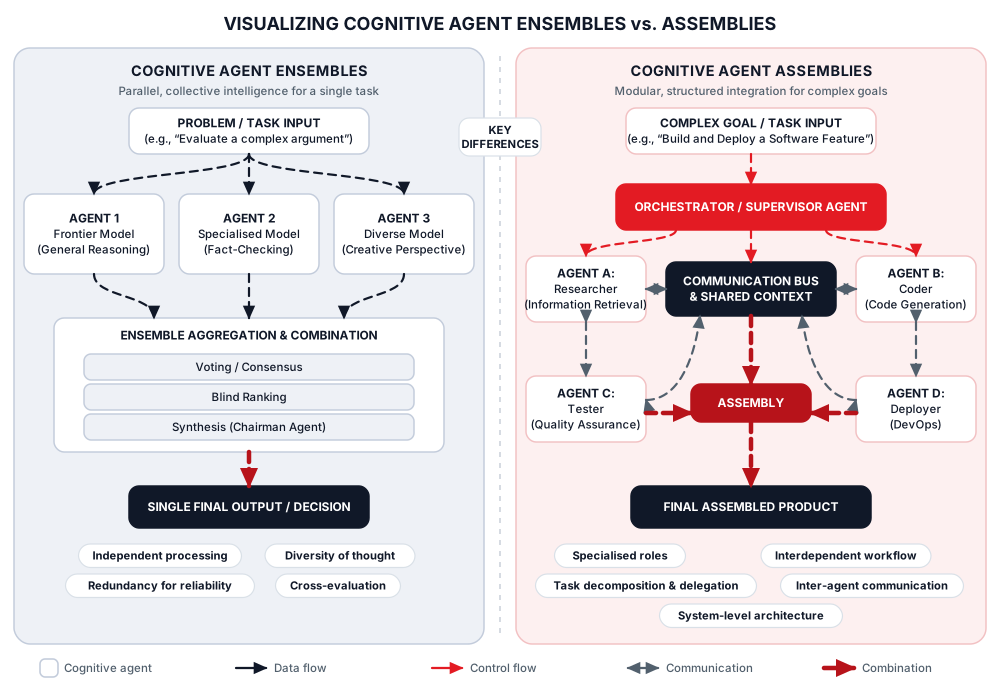
An agent ensemble brings multiple cognitive agents together to address a single task. Each agent may use different models, knowledge sources or reasoning approaches to analyse a problem independently. Their outputs are combined through voting, consensus, ranking, synthesis or cross-evaluation to produce a final decision.
For a CSP, this could mean evaluating a complex network incident through multiple specialist perspectives, validating a proposed root cause, or assessing competing options for service restoration.
The value lies in diversity of thought, independent validation and reduced dependence on a single model. Ensembles can improve decision quality and resilience, particularly where accuracy and confidence matter. However, diversity alone does not guarantee correctness; outputs must still be validated against trusted evidence and appropriate policies.
Agent Assemblies: Modular Intelligence for Complex Outcomes
An agent assembly integrates specialised agents into a structured workflow to achieve a broader business goal.
An orchestrator or supervisor decomposes the objective, delegates subtasks and coordinates execution. Specialist agents perform defined roles, while shared context and inter-agent communication allow their outputs to inform subsequent activities.
Consider automated service delivery. A research agent retrieves relevant information, a coding agent implements changes, a testing agent validates quality, and a deployment agent manages release activities. Together, they contribute to an end-to-end outcome rather than a single answer.
For CSPs, similar architectures could support service provisioning, network assurance, incident resolution, change management and customer lifecycle processes.
The Strategic Prize: Reusability and Investment Leverage
The most compelling benefit is the ability to treat agents as reusable enterprise assets rather than isolated, one-off solutions.
A network diagnostics agent developed for incident management might also support service assurance, predictive maintenance and customer-impact analysis. A policy-validation agent could be reused across provisioning, change management and compliance workflows.
This creates a powerful investment multiplier: build a specialist capability once, secure and govern it properly, and reuse it wherever it creates value.
Agent ensembles improve the quality of individual decisions; agent assemblies turn specialised capabilities into repeatable business outcomes. Used together, they offer CSPs a pathway from fragmented AI initiatives to an extensible enterprise AI operating model.
Security and Guardrails: Foundational, Not Optional
As agents gain access to network systems, customer data, operational tools and business workflows, security must be embedded at every architectural layer. An agent that can reason, communicate, invoke tools or initiate actions introduces risks beyond those of a conventional AI assistant.
Security cannot be confined to the model or added as a final compliance checkpoint. It must span the complete agent lifecycle and the entire ensemble or assembly.
Key principles include:
- Identity and access: Give every agent a verifiable identity and least-privilege permissions. Restrict access to the specific data, tools and systems required for its role.
- Data and context protection: Enforce data classification, privacy, encryption and access controls across knowledge bases, memory, shared context and inter-agent communication.
- Model and input security: Defend against prompt injection, malicious content, data poisoning and attempts to manipulate agent behaviour, including through retrieved documents and tool outputs.
- Tool and action guardrails: Validate proposed actions against explicit policies before execution. Require human approval for high-impact or irreversible operations, such as sensitive network changes or privileged production deployments.
- Orchestration security: Ensure the supervisor cannot bypass downstream controls, delegate beyond authorised boundaries or grant agents excessive privileges. Apply policy checks to agent-to-agent requests and hand-offs.
- Runtime monitoring and containment: Log decisions, tool calls and privileged actions; detect anomalous behaviour; enforce limits on spending, execution time and action frequency; and provide mechanisms to revoke access, isolate agents and stop workflows.
- Governance and accountability: Establish clear ownership, audit trails, testing requirements, risk classification and ongoing performance and security reviews.
Guardrails should operate as multiple, independent layers of defence: before an agent acts, while it executes, and after its actions are recorded and evaluated. No single model-based safety check should be trusted as the sole control.
For CSPs, this is particularly important because an agent’s actions can potentially affect network availability, customer privacy, service continuity and regulatory obligations. The appropriate degree of autonomy should therefore reflect the business impact and reversibility of each action.
Security is not simply a cost of enabling agentic AI. It is an essential condition for scaling it with confidence.
Additional Benefits for CSP Leadership
Beyond reuse and security, this architecture offers several strategic advantages:
- Faster time to value: Reuse proven agents rather than rebuilding capabilities for every initiative.
- Lower total cost of ownership: Reduce duplicated development, integration and maintenance effort.
- Operational agility: Introduce, upgrade or replace specialist agents without redesigning entire workflows.
- Enterprise scalability: Extend successful patterns across network, IT, customer operations and commercial functions.
- Improved quality and resilience: Combine specialist expertise, independent validation and cross-evaluation where appropriate.
- Consistent governance: Apply common standards for access, auditability, policy enforcement and performance.
- Continuous improvement: Enhance individual agents and propagate improvements across multiple business processes.
- Investment transparency: Measure the value of shared capabilities across use cases rather than assessing each AI initiative in isolation.
- Controlled autonomy: Automate more complex workflows while retaining appropriate human oversight and operational safeguards.
A C-Suite Imperative
Realising this value requires more than technology. CSPs need an enterprise architecture that supports agent discovery, reusable interfaces, orchestration, secure context sharing, policy enforcement, observability and clear accountability.
They also need an investment model that encourages reuse across organisational boundaries, with clear ownership of shared agents and measurable outcomes for each consuming business function.
The strategic question is no longer simply, “Where can we deploy AI agents?”
It is: “How do we build a secure, governed portfolio of reusable intelligence that compounds in value with every new use case?”
CSPs that answer this well will be better positioned to leverage existing investments, accelerate transformation and scale agentic AI responsibly—converting individual capabilities into sustainable enterprise advantage.
About the Author
Chief AI Officer at Taskgentic.ai. Leading the development of enterprise agent architectures that combine collective intelligence, modular workflows and rigorous security guardrails for complex operational environments.
About Taskgentic.ai
Taskgentic.ai is pioneering the next generation of AI-driven task intelligence—helping enterprises move from isolated AI agents to secure, reusable and governed ensembles and assemblies that deliver measurable business outcomes.