

A 5G network slice is sold to an enterprise as a single service with a service level agreement (SLA). Behind that promise sit a radio access network, a mobile core and a transport network, each with its own technology, controllers, vendors and standards. Delivering that promise manually, and keeping it for the life of the contract, does not scale.
Multi-agent systems (MAS) offer a practical operating model for that complexity. But the agents are probabilistic and the network is deterministic, so success depends as much on the guardrails as on the intelligence. This article explains the value, how to realise a return, and the layered controls CSP leaders should insist on.
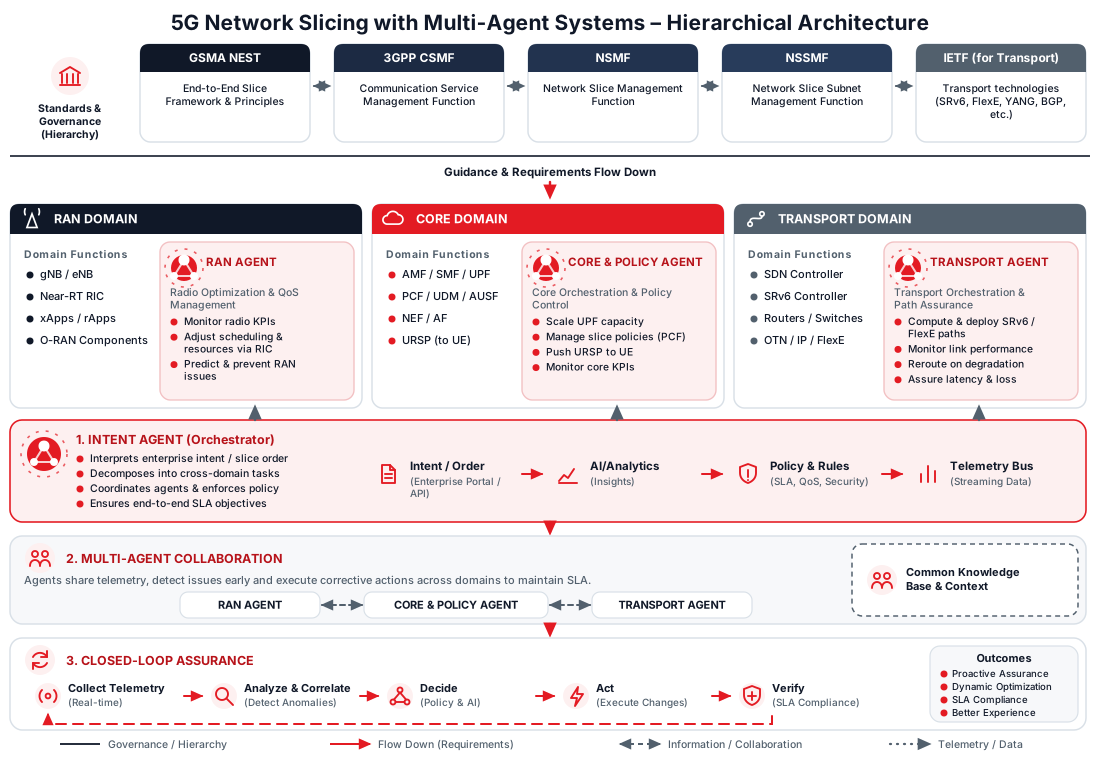 (opens the full-size diagram in a new tab)
Why 5G Slicing Is a Complexity Problem
Slicing is often described as a feature of 5G. In operations it is a coordination problem that crosses technology domains, standards bodies and organisational boundaries:
- Multiple technology domains: The radio domain brings gNB and eNB nodes, the Near-RT RIC, xApps and rApps and O-RAN components. The core brings AMF, SMF and UPF, PCF, UDM and AUSF, NEF and AF, and URSP rules for the device. The transport network brings SDN and SRv6 controllers, routers and switches, and OTN, IP and FlexE technologies.
- Multiple standards: GSMA slice templates provide the end-to-end framework and principles. The 3GPP management functions, from the communication service level down to the network slice and slice subnet, translate requirements into domain actions. Transport relies on technologies such as SRv6, FlexE, YANG models and BGP.
- Cross-domain dependencies: Degradation in transport breaks a radio-side SLA, and a policy change in the core alters what the radio network must deliver. No single domain team sees the whole picture.
- Continuous change: Slices are created, modified, scaled and assured for as long as the contract runs, against commitments on latency, throughput, reliability and isolation.
Manual coordination across these domains means slow activation, reactive fault handling and a growing operating cost for every slice sold. That limits both the number of slices a CSP can profitably offer and the SLAs it can safely promise.
Why a Multi-Agent System Fits
The architecture in the diagram mirrors the structure of the problem. Specialised agents own each domain, an orchestrating agent owns the end-to-end outcome, and a closed loop keeps the SLA honest. It works in five layers:
- Standards and governance flow down. GSMA, 3GPP and IETF-related guidance defines the framework within which agents operate. Requirements flow down from standards to slice orders to domain actions, so automation stays aligned with how the industry defines slices.
- Domain agents act inside each domain. A RAN agent monitors radio KPIs, adjusts scheduling and resources through the RIC and predicts and prevents radio issues. A core and policy agent scales UPF capacity, manages slice policies through the PCF, pushes URSP rules to devices and monitors core KPIs. A transport agent computes and deploys SRv6 or FlexE paths, monitors link performance, reroutes on degradation and assures latency and loss.
- The intent agent orchestrates. It interprets the enterprise intent or slice order, decomposes it into cross-domain tasks, coordinates the domain agents, enforces policy and keeps the end-to-end SLA objective in view. Orders arrive from an enterprise portal or API and pass through analytics, policy and rules, and a telemetry bus.
- Agents collaborate. They share telemetry and a common knowledge base and context, detect issues early and take corrective action across domains to maintain the SLA, rather than optimising each domain in isolation.
- A closed loop assures the outcome. The loop collects real-time telemetry, analyses and correlates it to detect anomalies, decides using policy and AI, acts by executing changes and verifies SLA compliance, then repeats.
The Business Value Multi-Agent Systems Offer
- Faster time to revenue: Slice orders are turned into configured, tested services across domains in a fraction of the manual coordination effort, so enterprise slices can be sold and activated at pace.
- Lower cost to operate: Fewer manual hand-offs between RAN, core and transport teams, and less reactive firefighting, reduce the operating cost of each slice.
- Protected SLAs: Proactive detection and cross-domain correction reduce SLA breaches, and the credits, disputes and reputational damage that follow.
- Better use of assets: Dynamic optimisation, such as scaling UPF capacity and steering transport paths to demand, improves utilisation of expensive network resources.
- A new commercial model: Reliable assurance lets CSPs price slices on committed outcomes, and offer differentiated enterprise services with confidence.
- Scarce skills multiplied: Specialist engineers supervise and refine agents instead of performing repetitive cross-domain coordination.
Realising the Return on Investment
Return does not come from automating a single slice. It comes from building a platform that serves many slices and domains. Five practices make the difference:
- Start with a bounded, valuable slice. Choose one enterprise use case with a clear SLA and commercial value, so benefits and risks can be measured.
- Baseline before you build. Record order-to-activation time, manual touches per slice, SLA breaches, fault resolution time and operating cost, so improvement can be shown to the board.
- Stage the autonomy. Move from agents that recommend, to agents that act with approval, to agents that act alone within defined limits, as evidence builds.
- Reuse relentlessly. Domain agents, shared context and guardrails built for the first slice should serve the second and the tenth. Reuse is where the cost per slice falls.
- Tie benefits to the commercial model. Link assured SLAs to pricing and retention, and track the cost of failures avoided as well as the cost saved.
Probabilistic Agents in a Deterministic Network
The central design challenge is a mismatch of natures. A network is deterministic: a route either exists or it does not, a UPF either has capacity or it does not, and an SLA is either met or breached. The large language models that power agents are probabilistic. Given the same situation, they may reason differently, may be wrong with confidence, and can be manipulated through the content they read.
The answer is not to avoid agents, but to place their probabilistic reasoning inside deterministic controls, so that nothing reaches the network unless it passes checks that behave the same way every time. Layered security and guardrails should work before an agent acts, while it acts and after it has acted:
- Identity and least privilege. Every agent has its own identity and only the permissions its domain requires. The RAN agent cannot alter core policy, and the transport agent cannot touch radio resources.
- Policy-as-code before action. A deterministic policy engine checks every proposed action against SLA, safety, regulatory and change rules, and allows, denies or limits it.
- A constrained action space. Agents choose from catalogues of pre-approved, tested actions, such as scaling UPF capacity within limits or rerouting over approved paths, instead of issuing free-form commands to network elements.
- Validation before commitment. Proposed changes are checked against current network state, and where possible simulated, before they are applied.
- Graduated autonomy and human approval. Autonomy is set by risk and reversibility. High-impact changes, such as those affecting several slices or core-wide behaviour, need human approval.
- Limited blast radius and rollback. Scope limits, rate limits, automatic rollback and a kill-switch ensure that any single error stays small and recoverable.
- Closed-loop verification. Every action is followed by an SLA check, and the agents’ own behaviour is monitored for drift and anomalies.
- Defence against manipulation. Treat telemetry, tickets and partner feeds as untrusted input that may carry hidden instructions. Authenticate agent-to-agent traffic and keep data separate from instructions.
- Immutable audit and explainability. Every decision and action is recorded in a form that supports investigation, regulatory scrutiny and learning.
These controls are most effective as a shared capability rather than something rebuilt for each agent, as described in our article on the assurance fabric. They also depend on the shared understanding of the network and business set out in our article on context.
In a deterministic network, probabilistic agents earn the right to act one guardrail at a time.
What C-Level Leaders Should Ask
- Which slices, and which SLAs, are we protecting, and what is each worth commercially?
- What is our baseline today, and how will we show improvement?
- Which actions may agents take alone, which need approval, and who decides?
- Can we show, for any change to the network, who or what made it, why, and what checked it?
- Are we building reusable agents, context and guardrails, or one-off automation for each slice?
A question for every CSP leadership team:
For each slice we automate, can we show the SLA we protect, the guardrails around the agents, and the evidence that both worked?
About the Author
Chief AI Officer at Taskgentic.ai. Leading the development of enterprise agent architectures that combine collective intelligence, modular workflows and rigorous security guardrails for complex operational environments.
About Taskgentic.ai
Taskgentic.ai is pioneering the next generation of AI-driven task intelligence—helping enterprises move from isolated AI agents to secure, reusable and governed ensembles and assemblies that deliver measurable business outcomes.