

Communications Service Providers (CSPs) are moving from individual AI assistants to multi-agent systems (MAS): many specialised agents, working together, with access to networks, customer data, operations systems and partners. The question for the C-suite changes with that shift. It is no longer only “can the agents do the work?” but “can we trust, control and evidence what they do?”
The answer is an assurance fabric: a centralised layer of governance capabilities that every agent, tool and workflow passes through. This article explains why a multi-agent system needs one, and how each building block contributes to agent assurance.
 (opens the full-size diagram in a new tab)
Why Multi-Agent Systems Change the Assurance Problem
A single assistant that answers questions is relatively easy to supervise. A multi-agent system is different in kind. Agents call tools, change configurations, raise orders and talk to each other. Their interactions create behaviour that no individual agent was designed to show.
- Conflicting actions: Two agents can propose contradictory changes to the same part of the network at the same time.
- Cascading errors: One agent’s mistaken output becomes another agent’s trusted input, and the error compounds.
- Privilege creep: An agent that can delegate to others may indirectly obtain access it was never granted.
- Unclear accountability: When many agents contribute to an outcome, it becomes hard to say who or what was responsible.
- Sprawl: Agents proliferate across teams and vendors, often with no common register of what exists or who owns it.
For a CSP, the consequences reach network availability, customer privacy, service continuity and regulatory obligations. Controls built separately into each agent are inconsistent and impossible to evidence at scale. Assurance has to be designed once, centrally, and applied to every agent.
The Architecture at a Glance
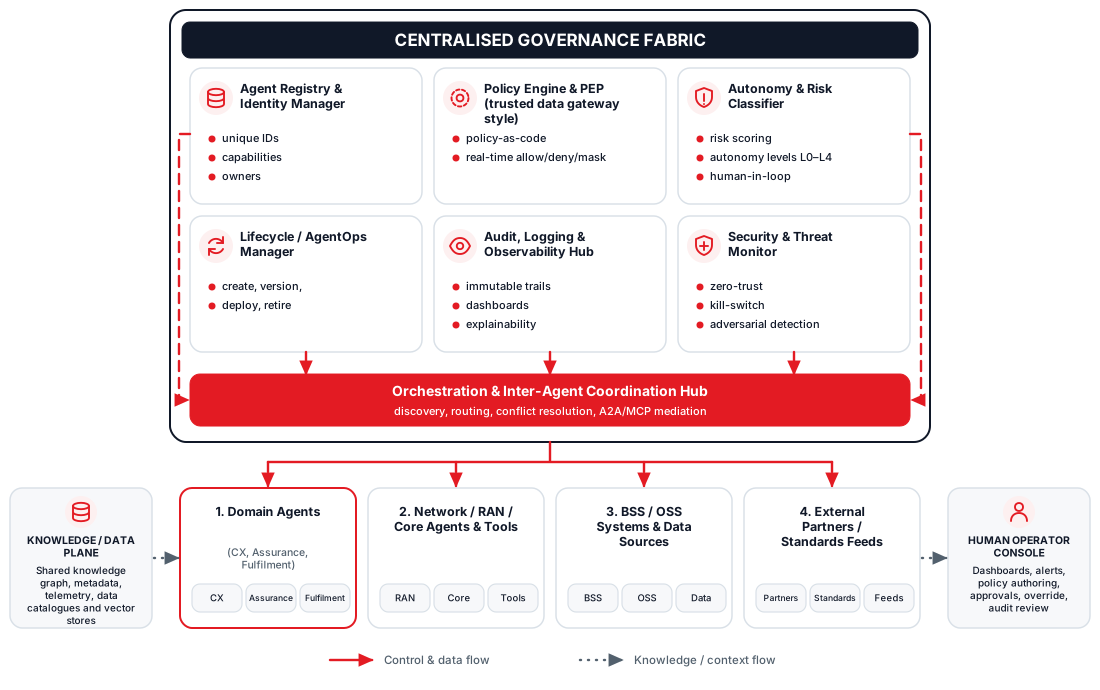
The diagram shows three layers working together. At the top sits the governance fabric, six capabilities that define who each agent is, what it may do, how much freedom it has, how it is managed, what it did and whether it is safe. In the middle sits the orchestration and coordination hub, through which agents are discovered, directed and mediated. Below sit the agents and the systems they act on.
Two planes surround the stack. The knowledge and data plane supplies shared context to the agents, as described in our article on context. The human operator console gives people visibility and authority over the whole system. Solid arrows show control and data flow; dotted arrows show knowledge and context flow.
The Six Governance Blocks and What Each Contributes to Assurance
Each block answers a question that a board, a regulator or an operations director will eventually ask:
- Agent Registry and Identity Manager: who is this agent? Every agent has a unique identity, a declared set of capabilities and a named owner. There are no anonymous agents, every action is attributable, and the registry is the basis for discovery and least-privilege access.
- Policy Engine and Policy Enforcement Point: what may it do? Policy is written as code and enforced in real time at a gateway, in the style of a trusted data gateway. Each request to access data or take an action is allowed, denied or masked consistently, so sensitive customer data is protected and rules are versioned and testable.
- Autonomy and Risk Classifier: how much freedom should it have? Risk scoring sets graduated autonomy levels, from L0 to L4, with humans in the loop where the impact or irreversibility is high. Autonomy is earned and adjustable rather than assumed.
- Lifecycle and AgentOps Manager: is it the right version? Agents are created, versioned, deployed and retired under control. Testing gates, rollback and retirement keep unproven or obsolete agents out of production and prevent sprawl.
- Audit, Logging and Observability Hub: what did it do, and why? Immutable trails, dashboards and explainability provide the evidence for incident investigation, regulatory scrutiny and board confidence, and they reveal drift in agent behaviour early.
- Security and Threat Monitor: is it being attacked or misbehaving? Zero-trust principles, adversarial detection and a kill-switch defend against manipulation such as prompt injection and data poisoning, and allow any agent or workflow to be isolated or stopped immediately.
The Coordination Hub: Where Assurance Is Enforced
The orchestration and inter-agent coordination hub handles discovery, routing, conflict resolution and the mediation of agent-to-agent (A2A) and Model Context Protocol (MCP) traffic. It is where governance becomes operational. Because every interaction passes through it, the hub can check identity against the registry, apply policy, respect the autonomy level, log the exchange and arbitrate between conflicting requests.
Without this single point of mediation, agents would connect directly to one another and to tools, and the fabric would have nothing to enforce.
The Agents, Systems and Planes Around the Fabric
- Domain agents: Customer experience, assurance and fulfilment agents deliver business outcomes, and are the most visible users of the fabric.
- Network, RAN and core agents and tools: These act closest to the network, where the cost of error is highest, so they are subject to the strictest autonomy and policy controls.
- BSS and OSS systems and data sources: The systems of record that agents read and change. The fabric ensures access is deliberate, masked where necessary and fully logged.
- External partners and standards feeds: Third-party agents and information enter the estate here. They are treated as untrusted until verified and governed like any other participant.
- Knowledge and data plane: The shared knowledge graph, metadata, telemetry, data catalogues and vector stores that give agents context.
- Human operator console: Dashboards, alerts, policy authoring, approvals, override and audit review keep people in command of the system.
Why This Matters to the C-Suite
- Trust and licence to operate: Customers, regulators and boards will expect evidence that autonomous systems are under control.
- Scale without sprawl: A central register and lifecycle keep the agent estate visible, owned and rationalised.
- Consistent control: One set of identity, policy and risk rules applies to every agent, whichever team or vendor built it.
- Contained impact: Graduated autonomy, policy gateways and a kill-switch limit how far any single failure can spread.
- Speed with confidence: Pre-approved patterns and automated checks let teams deploy new agents faster, because the safety case is already built in.
- Efficiency: Governance capabilities are built once and reused, instead of being rebuilt inside every agent project.
Where to Start
- Know what you have. Inventory existing agents, tools and pilots, and give each an identity and an owner.
- Put a gateway in front of data and actions. Introduce policy-as-code enforcement for the highest-value and highest-risk workflows first.
- Classify use cases by risk. Set the autonomy level for each, and define when a person must approve.
- Log from day one. Make audit trails immutable and explainable before agents go into production, not after an incident.
- Give operators control. Provide a console with alerts, approvals, override and a tested kill-switch.
- Mediate agent-to-agent traffic. Route inter-agent and tool communication through a coordination hub so that governance can be enforced.
Governance is not the brake on agentic AI. It is what allows a CSP to accelerate with confidence.
The patterns in our article on ensembles and assemblies and the shared context described in our article on context only create value if they run on a foundation that can be trusted.
A question for every CSP leadership team:
If we deployed fifty agents next quarter, could we say who they are, what they may do, and what they did?
About the Author
Chief AI Officer at Taskgentic.ai. Leading the development of enterprise agent architectures that combine collective intelligence, modular workflows and rigorous security guardrails for complex operational environments.
About Taskgentic.ai
Taskgentic.ai is pioneering the next generation of AI-driven task intelligence—helping enterprises move from isolated AI agents to secure, reusable and governed ensembles and assemblies that deliver measurable business outcomes.