

TM Forum’s Value Operations Framework provides a strong foundation for connecting AI and automation to business outcomes. The next step is to close the gap between operational improvement and verified financial return.
There is no shortage of ambition around AI in telecommunications. Communications service providers (CSPs) are investing in intelligent network operations, AI-powered customer service, software engineering automation and, increasingly, agentic AI that can plan and execute tasks with limited human intervention.
The promise is compelling: lower operating costs, fewer network incidents, better customer experiences, faster service delivery and new revenue opportunities.
Yet a difficult question remains for many executive teams: how much financial value is AI actually delivering, after accounting for the full cost of implementing and running it?
A network operations team may demonstrate that AI reduces fault-diagnosis time. A customer service team may report faster handling times. An IT organisation may show that developers are producing code more quickly. These are meaningful improvements, but they do not automatically translate into lower expenditure, higher margins or better cash flow.
For a CFO, the distinction is fundamental.
Improving an operational metric is not the same as improving the P&L. And a promising pilot is not the same as a sustainable financial return.
TM Forum’s Value Operations Framework (VOF) provides a useful foundation for addressing this challenge. The opportunity now is to build on that foundation with a more consistent approach to AI lifecycle economics and financial assurance, giving CSP leaders greater confidence in the value they report, the investments they approve and the decisions they make about scaling AI.
What TM Forum’s VOF brings to the table
TM Forum’s Value Operations Framework is designed to help CSPs understand, measure and manage the business value created by operational transformation, particularly intelligent automation and autonomous operations.
Its central principle is straightforward: technology improvements matter because of the business outcomes they enable.
VOF helps establish the relationship between operational measures, business performance indicators and broader business objectives. Rather than evaluating an initiative solely on technical performance, it encourages CSPs to understand how changes in network, service or IT operations contribute to outcomes such as revenue growth, customer satisfaction, innovation and operational efficiency.
Consider an AI-based network fault-management solution.
The technology might identify faults more accurately, reduce diagnosis time and automate more remediation activities. Those improvements could lead to faster service restoration, fewer repeat incidents and better network availability. In turn, these outcomes might reduce engineer costs, avoid service credits, protect customer relationships and improve the economics of network operations.
VOF provides a way to structure these relationships and make the expected sources of value more visible.
That is important because AI programmes can otherwise become a collection of disconnected initiatives, each reporting its own measures of success. One team reports automation rates, another reports hours saved, and a third reports improved customer satisfaction. Without a common value model, the executive team is left to work out how those results fit together and what they mean for the business.
VOF helps create that shared understanding.
It is not, however, intended to be a universal financial accounting standard for every AI investment. Its particular strength lies in connecting operational transformation to business value. Turning that value into a consistent, finance-validated measure of net return requires additional discipline.
Cost-benefit analysis is already part of TM Forum’s work
It would be unfair to suggest that TM Forum has ignored the financial side of transformation.
Its VOF-related guidance explicitly includes cost-benefit analysis as a method for assessing the impact of intelligent automation and autonomous operations. TM Forum also provides guidance on building business cases for autonomous operations, covering the costs, benefits, risks and assumptions that inform investment decisions.
These are important foundations. They recognise that CSPs need to understand both the potential benefits of transformation and the investment required to achieve them.
The distinction is between having cost-benefit analysis available as part of a value assessment and having a consistently applied financial methodology across an entire AI portfolio.
A project team may build a sound business case for one autonomous-network initiative. Another team may evaluate a generative AI customer-service assistant. A third may invest in an enterprise AI platform shared across dozens of applications.
Each may use different assumptions about implementation costs, ongoing support, infrastructure consumption, productivity gains and the financial value of released capacity.
Even when individual business cases are credible, comparing them becomes difficult if they use different definitions of benefit, different cost boundaries and different approaches to measuring realised value.
The question is therefore not whether VOF can accommodate financial analysis. It can. The question is whether CSPs have a sufficiently consistent and auditable method for applying that analysis to AI investments across the enterprise.
That is where a complementary framework could make a material difference.
The missing link: the full economics of AI
AI economics are more complicated than the cost of a software licence or a cloud invoice.
An AI solution can involve significant upfront expenditure on integration, data preparation, process redesign, testing and implementation. Once deployed, it may require model inference, compute capacity, data pipelines, platform licences, monitoring, security controls, human oversight and ongoing engineering support.
Agentic AI introduces further considerations. Systems that plan and execute multi-step tasks may consume variable amounts of compute and model capacity. They also need controls for exceptions, permissions, quality assurance and escalation to human operators. The cost of managing these activities can change as usage grows.
Some costs sit within the project budget. Others are absorbed by central technology teams, shared platforms or existing operational functions. If these costs are not allocated consistently, an AI use case can appear profitable because part of its economic burden is recorded somewhere else.
The benefits can be equally difficult to interpret.
Suppose AI reduces the time required to handle a customer enquiry by 20%. That improvement releases capacity. But unless the CSP reduces staffing expenditure, avoids planned recruitment, handles additional profitable demand or redeploys the capacity to work that would otherwise have required additional resources, the saving may not translate directly into a financial benefit.
The same principle applies to network operations. Faster fault resolution may improve availability and customer experience, but the financial impact depends on the costs avoided, the revenue protected and the extent to which those benefits can reasonably be attributed to the AI intervention.
The real gap is the absence of a consistently applied bridge between operational value, the full cost of AI and verified financial outcomes.
This is not a claim that TM Forum’s VOF excludes costs, nor that CSPs cannot build rigorous financial controls around it. It is a recognition that a common, enterprise-wide approach to lifecycle costing and financial validation would make AI investment decisions more consistent and defensible.
Why this matters to CSP CFOs
For a CFO, the challenge is not simply to establish whether AI works. It is to determine whether AI is creating enough value to justify the capital and operating expenditure, and whether that value is sustainable.
There are four reasons this matters.
- AI spending is becoming harder to separate from business-as-usual expenditure. As AI becomes embedded in platforms, networks, customer operations and software development, the costs are increasingly distributed across multiple budgets. Without a consistent cost model, the true economics of an AI portfolio are difficult to see.
- Productivity gains can be mistaken for financial savings. Hours saved, increased automation and faster processing are useful indicators, but they are not necessarily cashable benefits. Finance needs to understand how operational improvements affect actual expenditure, avoided costs, revenue or margin.
- Investment decisions need to be comparable. A CSP should be able to compare an AI-based network assurance programme with a customer service agent or a software engineering assistant using consistent financial principles. Otherwise, the organisation risks favouring projects with the most attractive presentation rather than those with the strongest economic return.
- Scaling introduces new risks. A pilot may perform well at limited volume but become more expensive when rolled out across millions of customer interactions or a nationwide network. Model consumption, integration complexity, support requirements and human oversight can all grow with scale. A credible business case must account for those costs before the CSP commits to wider deployment.
For CFOs, the objective is not to make every AI initiative prove immediate cash savings. Some investments may create strategic options, improve resilience or enable new services. The objective is to distinguish those different forms of value, make the assumptions transparent and ensure that financial claims are proportionate to the evidence.
A complementary AI Lifecycle Economics and Value Assurance extension
The most practical way forward is to build on VOF rather than replace it.
VOF can remain the framework for identifying where business value should arise and how operational improvements connect to business outcomes. A complementary AI Lifecycle Economics and Value Assurance extension would establish how the associated costs and benefits are measured, evidenced and validated.
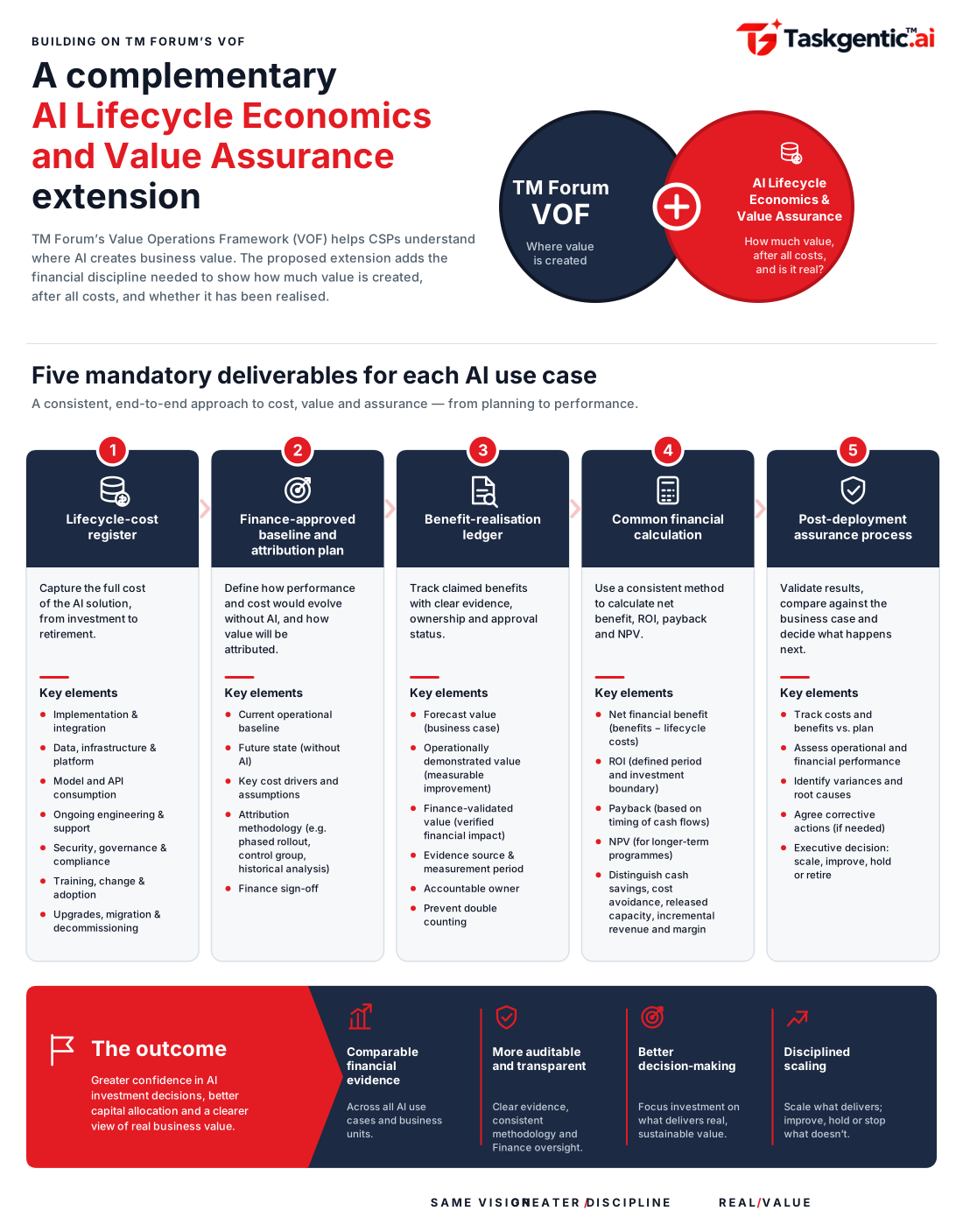
The extension should have five mandatory deliverables for every material AI use case.
 (opens the full-size diagram in a new tab)
1. A standard lifecycle-cost register
Every AI business case should use a common cost structure covering the full life of the solution, from initial investment through operation and eventual retirement.
This should include implementation and integration, data preparation, infrastructure, model and platform costs, ongoing engineering, monitoring, human oversight, security, governance, training and change management. It should also capture material costs associated with upgrades, migration and decommissioning.
Shared costs need particular attention. If several AI use cases depend on the same platform, CSPs need transparent allocation rules so that the costs are neither omitted nor counted multiple times.
The register should distinguish one-off investment from recurring operating expenditure and identify the assumptions behind forecast costs. Once the solution is deployed, actual expenditure should be compared with those forecasts.
This would give executives a more realistic view of what AI costs to deliver at scale, not simply what it costs to launch a pilot.
2. A Finance-approved baseline and attribution plan
Before deployment, each use case should establish how performance and cost would evolve without the AI intervention.
That means recording the existing operational baseline, the associated cost drivers and the expected future position if the CSP continues with its current approach. The assessment should account for factors such as changes in demand, wage inflation, network growth, process redesign and other transformation initiatives.
The plan should also explain how the CSP intends to attribute observed improvements to AI. Depending on the use case, this might involve a phased rollout, a comparison group, historical analysis or a carefully constructed operational model.
Finance should approve the baseline, measurement period, attribution method and assumptions before the pilot begins.
Doing this upfront is important. If the organisation only decides how to measure success after seeing the results, there is a risk that the benefits will be overstated or selectively interpreted.
A credible baseline makes it possible to distinguish the effect of AI from improvements that would have occurred anyway.
3. A benefit-realisation ledger
CSPs need a common record of the benefits claimed by each AI initiative, with clear definitions, evidence and ownership.
Crucially, the ledger should distinguish three stages of value.
- Forecast value represents the benefits expected in the business case. It is based on assumptions and projections, not demonstrated results.
- Operationally demonstrated value means the solution has delivered a measurable improvement in practice, such as reduced handling time, fewer repeat incidents or a higher rate of automated resolution. The operational improvement is evidenced, but its financial consequences may not yet be fully realised.
- Finance-validated value represents benefits that Finance has reviewed and accepted using the agreed methodology. These might include verified reductions in expenditure, demonstrably avoided costs, incremental contribution margin or quantified reductions in financial losses.
The ledger should record the value, measurement period, evidence source, accountable business owner, relevant costs and approval status. It should also prevent double counting—for example, claiming the same released capacity as both a labour saving and an additional productivity benefit.
This would give the executive team a much clearer picture of the difference between what AI is expected to deliver, what it has demonstrably improved and what it has actually contributed financially.
4. A common financial calculation
Once costs and benefits have been established, CSPs should use a consistent method to calculate net benefit, return on investment, payback and, where appropriate, net present value.
The basic principle is simple:
Net financial benefit = verified financial benefits − attributable lifecycle costs.
ROI should be calculated over a defined period, with the investment and benefit boundaries clearly stated. Payback should reflect the timing of expenditure and benefits rather than assume that a fully deployed solution generates its steady-state return immediately. For longer-term programmes, NPV can help account for the timing of cash flows and the cost of capital.
The methodology should also distinguish cash savings from cost avoidance, released capacity, incremental revenue and strategic benefits. These categories may all be relevant to the investment decision, but they should not be presented as if they were interchangeable.
Consider a network operations initiative that generates £2.5 million in verified annual financial benefits and incurs £1 million in annual operating costs. Its steady-state net annual benefit is £1.5 million. If implementation required a further £2 million, that initial investment must also be included when assessing the cumulative return and payback period.
The resulting figures are only as credible as the assumptions, attribution and cost data behind them. A common calculation is therefore necessary, but it is not sufficient without reliable evidence.
5. A post-deployment assurance process
The business case should not become a historical document that is revisited only when the project seeks further funding.
CSPs should compare actual costs and benefits against the original business case at defined intervals after deployment. The review should assess whether operational improvements have persisted, whether financial benefits have materialised, whether recurring costs are higher than expected and whether the solution continues to deliver an acceptable return.
Material variances should trigger an explanation and, where necessary, corrective action. A solution may need changes to its operating model, pricing, model selection or human-review process. In some cases, the appropriate decision may be to limit deployment or stop investing.
The process should culminate in a clear executive decision: scale, improve, hold or retire.
This is where lifecycle economics becomes a management discipline rather than a reporting exercise. It connects the original investment decision to ongoing financial accountability.
What would this change for the CSP executive team?
The value of the proposed extension would be greater consistency, transparency and confidence in AI investment decisions.
The CEO would have a clearer view of where AI is contributing to strategic priorities. The COO would understand which operational improvements are translating into measurable business outcomes. The CIO and Chief Data and AI Officer would have greater visibility of the full cost of the platforms and solutions they are deploying. The CFO would have a consistent basis for validating returns, challenging assumptions and allocating capital.
It would also help establish a common language between technology teams and Finance. Instead of debating whether an AI pilot was successful because it improved a technical metric, the conversation could move to what changed, what it cost, what financial value was realised and what should happen next.
That does not mean every benefit needs to be reduced to an immediate cash saving. Customer satisfaction, resilience, innovation and strategic flexibility can all matter. But their measures, assumptions and evidence should be explicit, so decision-makers can distinguish realised financial returns from broader strategic value.
TM Forum is well positioned to help CSPs establish this common approach. Its existing value framework, operational models and business-value assessment guidance provide a starting point for an extension that complements VOF and addresses the financial requirements of enterprise AI investment.
From measuring AI activity to proving AI value
Telecommunications does not need another set of AI success stories built around impressive demonstrations and isolated performance improvements. It needs a consistent way to determine which initiatives create durable business value, what that value costs to deliver and whether the expected return has materialised.
TM Forum’s VOF provides an important foundation by helping CSPs connect operational improvements to business outcomes. A complementary AI Lifecycle Economics and Value Assurance extension would take the next step: standardising lifecycle costs, establishing Finance-approved baselines, tracking benefits by evidence level, calculating returns consistently and validating performance after deployment.
The prize is not simply better reporting. It is better capital allocation, more disciplined scaling and greater confidence that AI investment is improving the economics of the business.
Ultimately, the question for CSP leaders is not whether AI can improve operations. It is whether they can demonstrate, with credible evidence, that the improvement is worth more than the full cost of achieving it.
About the Author
Chief AI Officer at Taskgentic.ai. Leading the development of enterprise agent architectures that combine collective intelligence, modular workflows and rigorous security guardrails for complex operational environments.
About Taskgentic.ai
Taskgentic.ai is pioneering the next generation of AI-driven task intelligence—helping enterprises move from isolated AI agents to secure, reusable and governed ensembles and assemblies that deliver measurable business outcomes.