

The next phase of AI in telecommunications will not be defined by how many agents a CSP deploys, but by how effectively it can coordinate, govern and scale them.
Communications service providers (CSPs) are entering a new phase of AI adoption. What began with individual use cases in customer service, network operations and IT automation is evolving towards systems of specialised AI agents working together to complete increasingly complex business and operational tasks.
The opportunity is significant. Imagine a network incident being identified, investigated and resolved through collaboration between agents responsible for network assurance, service inventory, fault management and change execution. Or a customer issue being resolved across CRM, billing, service assurance and fulfilment systems without requiring multiple teams to intervene.
This is where AI starts to move beyond improving individual tasks and begins to transform how the business operates.
But there is a fundamental challenge. As the number of agents grows, so does the complexity of managing their interactions, decisions, access to enterprise systems and execution of actions. Agents may be developed by different teams, sourced from different vendors, run on different platforms and operate across different parts of the business.
Managing them individually is relatively straightforward. Managing them collectively, particularly when they have the authority to act, is an entirely different proposition.
For CSPs, this is not simply a technology challenge. It is an issue of operational control, business accountability, security and economics.
The industry needs a Multi-Agent Control Layer: a common enterprise capability that ensures agents work together securely, reliably and within the boundaries of the business.
Why the challenge is particularly acute for CSPs
CSPs operate some of the most complex technology environments in any industry. They combine critical network infrastructure, legacy IT, cloud platforms, customer systems, operational technology and an extensive ecosystem of suppliers and partners.
AI agents will inevitably emerge across these environments. Network teams will deploy agents for assurance and optimisation; IT teams will use them for incident management and service automation; customer operations will introduce agents for service resolution and personalisation.
The risk is that these initiatives develop independently, creating a fragmented agent ecosystem with inconsistent security, governance, monitoring and operating practices.
The consequences become more significant as agents begin to collaborate and execute actions rather than simply provide recommendations.
There are six challenges CSP leadership needs to address.
1. Fragmented agents and disconnected operations
The value of multi-agent AI comes from connecting capabilities across organisational and technology boundaries. Yet most CSP environments remain organised around separate domains, platforms and processes.
A customer issue, for example, may require interaction between customer management, network assurance, service inventory, billing and fulfilment. Individual agents may be capable of handling their respective tasks, but without coordinated orchestration there is no guarantee that the overall process will work effectively.
Conflicting decisions, duplicated actions, inconsistent information and disconnected workflows can undermine the benefits of automation.
CSPs need a common mechanism to discover agents, understand their capabilities, coordinate their activities and manage dependencies across business domains.
The objective is not to replace existing systems or centralise every decision. It is to make independently developed capabilities work together as part of a coherent enterprise operating model.
2. Security, trust and accountability
Every agent that interacts with enterprise systems introduces a potential access and security risk.
Which data can it access? What actions can it perform? Can it modify a customer account, change a service configuration or initiate a network intervention? Who is accountable if it takes an incorrect action?
These questions become harder when agents interact with other agents, use external tools and operate across multiple vendor platforms.
Traditional application security controls are necessary, but they are not sufficient on their own. CSPs need to establish identities and permissions for agents, enforce policies consistently and maintain a clear record of decisions and actions.
Crucially, the ability to recommend an action must be distinguished from the authority to execute it.
A Multi-Agent Control Layer provides a common mechanism for identity, access management, policy enforcement, data protection and auditability. It ensures that security and accountability are built into agent interactions rather than addressed separately within each implementation.
3. Controlling autonomy in business-critical environments
The attraction of agentic AI is its ability to make decisions and take action with limited human intervention. For CSPs, however, unrestricted autonomy is not an option.
An incorrect recommendation in a customer interaction may create dissatisfaction. An incorrect action in network operations could affect service availability, trigger further faults or impact large numbers of customers.
The answer is not to restrict agents to providing recommendations. That would limit much of their potential value. Instead, autonomy must be governed according to business impact and operational risk.
Routine, low-risk activities can be automated. More consequential actions should require additional validation, while changes with significant network or customer impact may need explicit human approval.
The control layer should enforce these boundaries through decision policies, approval mechanisms, escalation paths and the ability to stop or suspend agent activity.
For CSPs, this is fundamental: autonomy should be earned through demonstrable reliability and controlled through clearly defined business rules.
4. Operational resilience and end-to-end visibility
Multi-agent systems introduce new failure scenarios. One agent may become unavailable, another may return incomplete information, an external API may fail or a workflow may stall after an action has been initiated.
The challenge is not simply detecting that an agent has failed. It is understanding the impact on the wider process and ensuring that recovery does not create additional problems.
For example, automatically retrying a failed service order could result in duplicate provisioning if the original request had actually succeeded.
CSPs therefore need workflow-level exception management, controlled retries, recovery mechanisms and the ability to escalate unresolved issues to operational teams.
Equally important is visibility. It is not enough to monitor individual agents or model performance. Operations teams need to understand how agents interact, what decisions they make, which tools they access and how those interactions affect the final business outcome.
A Multi-Agent Control Layer provides the operational oversight needed to trace activity across the entire workflow, investigate failures and maintain service reliability.
This is particularly important in telecommunications, where operational resilience and service continuity are non-negotiable.
5. Cost, capacity and commercial control
As agent adoption grows, the economics can become difficult to manage.
A single business transaction may involve multiple agents, model calls, data retrieval operations and external tool interactions. Poorly designed workflows can generate unnecessary processing, increase latency and drive up consumption costs.
The cost of running an individual agent tells only part of the story. CSPs need to understand the total cost of completing a business outcome.
This requires visibility into token consumption, model usage, compute capacity, tool calls and workflow-level expenditure. It also requires the ability to select appropriate models, allocate resources intelligently and avoid unnecessary agent interactions.
A control layer makes it possible to connect technology consumption with business value.
For executives, the question is not how many agents are running or how many tokens they consume. It is whether they are reducing cost per transaction, improving operational productivity and delivering measurable improvements in customer and network performance.
Without this visibility, the economics of agentic AI could quickly become another source of uncontrolled technology expenditure.
6. Governance, data and vendor independence
CSPs must operate within demanding security, privacy and regulatory environments. They also need to maintain control over sensitive customer information, network data and business-critical processes.
When multiple agents access different data sources and operate across platforms from different providers, consistent governance becomes difficult.
Agents may rely on outdated information, interpret conflicting data or apply different policies to similar situations. At the same time, reliance on proprietary agent frameworks could create vendor dependencies and make it harder to evolve the architecture.
CSPs need common standards for data access, information provenance, agent registration, policy enforcement and audit records.
They also need an architecture that allows agents, models and tools from different providers to coexist without creating separate governance structures for each.
The control layer should provide this consistency while preserving the flexibility to adopt new technologies and retain existing enterprise investments.
The Multi-Agent Control Layer: An enterprise necessity
Addressing these challenges requires more than adding another orchestration tool or extending existing automation platforms. CSPs need an overarching control capability that brings the agent ecosystem under a consistent operating model.
At its core, a Multi-Agent Control Layer should provide seven capabilities:
- Agent registry and lifecycle management: A central view of approved agents, their capabilities, ownership, status and lifecycle.
- Security and policy enforcement: Consistent identity, access, authorisation, data protection and usage policies.
- Workflow orchestration: Coordination of agents, task routing, decision rules, dependencies and human approvals.
- Exception management and recovery: Detection, containment and resolution of failures across multi-agent workflows.
- Observability and audit: End-to-end visibility into agent interactions, decisions, actions and outcomes.
- Resource and cost management: Control of model usage, tokens, compute capacity and workflow economics.
- Governance and accountability: Clear ownership, approval thresholds, audit trails and mechanisms to intervene when required.
These capabilities should operate as a common control plane across the enterprise, integrating with existing security, data, infrastructure and operations platforms.
It should not become another monolithic system or attempt to replace established CSP platforms. Its purpose is to provide the missing layer that connects and governs the growing ecosystem of agents.
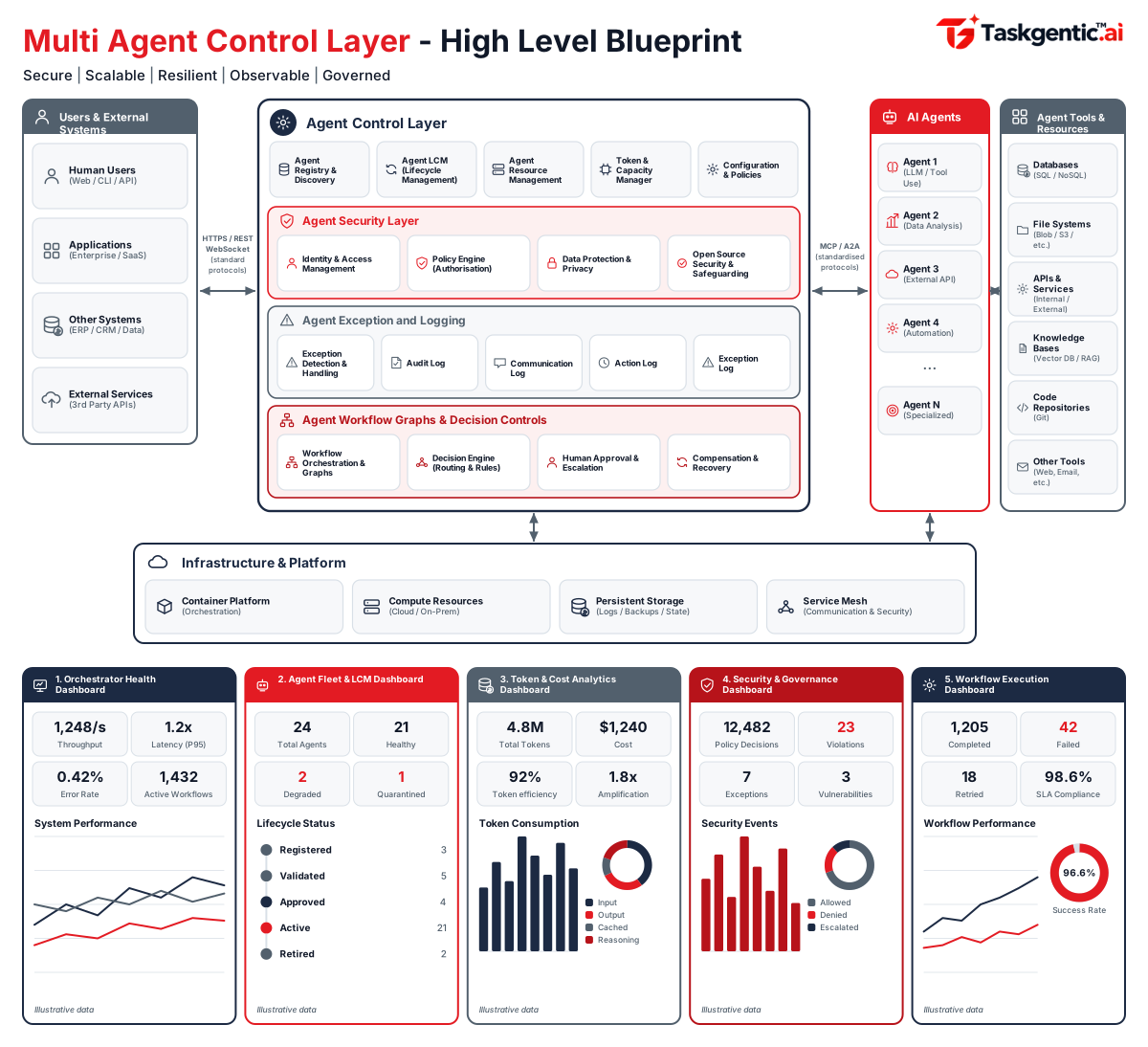 (opens the full-size diagram in a new tab)
Moving from experimentation to enterprise scale
CSPs do not need to implement everything at once. The priority should be to establish control before agent deployments become too fragmented and difficult to govern.
A sensible starting point is to identify a small number of cross-domain use cases where multiple agents need to collaborate, such as network incident management, customer issue resolution or IT operations.
These deployments should establish the essential controls around agent identity, permissions, workflow orchestration, monitoring, exception handling and human oversight.
Success should be measured against business outcomes: reduced resolution times, improved first-time-right execution, lower operational costs, fewer service-impacting errors and better customer experience.
As confidence and maturity grow, the control layer can be extended across more agents, business functions and operational domains.
Importantly, ownership must sit across the business, not solely within IT or AI teams. Network operations, customer experience, security, compliance and finance all have a stake in how autonomous systems are governed.
The leadership question
Multi-agent AI represents an important opportunity for CSPs to fundamentally rethink how their businesses operate. But the ability to deploy agents is not, in itself, a competitive advantage. The advantage will come from deploying them at scale, making them work together and ensuring that their actions consistently deliver business value.
Without a common control framework, CSPs risk creating another layer of technology fragmentation, operational complexity and unmanaged cost. With one, they can build a more flexible, responsive and increasingly autonomous operating environment without compromising security, resilience or accountability.
The Multi-Agent Control Layer should therefore be viewed as a strategic enterprise capability, not simply another component of the AI technology stack.
The question for CSP leaders is no longer whether to embrace multi-agent AI. It is whether they have the control infrastructure to scale it safely, economically and with confidence.
About the Author
Chief AI Officer at Taskgentic.ai. Leading the development of enterprise agent architectures that combine collective intelligence, modular workflows and rigorous security guardrails for complex operational environments.
About Taskgentic.ai
Taskgentic.ai is pioneering the next generation of AI-driven task intelligence—helping enterprises move from isolated AI agents to secure, reusable and governed ensembles and assemblies that deliver measurable business outcomes.