

Why the next wave of CSP transformation must be driven by business value, not the pursuit of AI.
The telecommunications industry does not need another reason to be excited about artificial intelligence. The potential of Agentic AI is already attracting significant attention across the sector. The prospect of intelligent agents working across network operations, customer service, service assurance, planning and business support is compelling. It promises faster decisions, greater automation, improved productivity and more responsive operations.
But there is a question that should come before any discussion of agents, platforms, architectures or use cases:
What business outcome are we actually trying to achieve?
For Communications Service Providers (CSPs), this is more than a question of investment discipline. It is a question of strategic direction. The industry has invested heavily in digital transformation, automation, cloud, data platforms and AI. Yet technology investment does not automatically translate into better business performance. Too often, organisations measure progress through the capabilities they have deployed rather than the value those capabilities have delivered.
Agentic AI presents an opportunity to change that. But only if CSPs resist the temptation to make the technology the starting point.
The real opportunity is not to deploy more AI agents. It is to become more profitable, productive, resilient and customer-centric by using the right combination of technology, process, people and organisational change.
That requires a different approach to managing the lifecycle of Agentic AI.
The real opportunity is business transformation, not AI adoption
Agentic AI could have a profound impact on telecommunications. Agents may help identify network problems before they affect customers, coordinate complex service restoration activities, improve capacity planning, accelerate service fulfilment and reduce the manual effort involved in managing increasingly complex operations.
However, these are capabilities, not business outcomes.
Reducing the time taken to diagnose a network fault is useful. Reducing customer-impacting incidents, improving service availability and lowering the cost of service assurance are the outcomes that matter.
Automating elements of order management may improve processing speed. Reducing order fallout, shortening time to revenue and improving the customer experience are the results that should justify the investment.
Similarly, deploying agents to support network planning is not an end in itself. The value comes from making better investment decisions, using network resources more effectively, avoiding unnecessary capital expenditure and improving network performance.
This distinction matters because it changes the conversation at the executive level. Instead of asking how many agents can be deployed, or how much of a process can be automated, leaders should be asking where the organisation is losing value, where it has an opportunity to improve performance, and whether Agentic AI is the right way to address it.
The answer will not always be AI. In some situations, the greatest benefit may come from simplifying a process, improving data quality, integrating existing systems or applying conventional automation. Agentic AI should be selected because it offers a credible advantage in achieving the desired outcome, not because it is the technology attracting the most attention.
Before investing, understand the value of acting — and the cost of doing nothing
A business case should do more than demonstrate that a proposed solution is technically feasible or that a pilot has produced encouraging results. It should establish why the organisation should invest, what it stands to gain, what it risks by not acting and whether the expected return justifies the commitment.
The cost of inaction is particularly important and is often overlooked.
Consider a CSP experiencing persistent network incidents, high levels of repeat faults and significant manual effort in service assurance. The investment case should not focus solely on the potential efficiency gains from introducing AI agents. It should also consider the ongoing cost of operating in the current way: unnecessary operational expenditure, lost productivity, customer dissatisfaction, potential churn, service-level penalties and the impact of recurring incidents on network performance.
The same principle applies across the business. Delayed service activation can mean delayed revenue. Poor resource utilisation can increase operating costs and constrain capacity. Inefficient customer interactions can drive avoidable contact volumes and weaken loyalty. Fragmented operational processes can slow decisions and increase the cost of delivering services.
Understanding these consequences creates a much stronger basis for investment. It also helps leaders distinguish between an interesting technology opportunity and a business priority that genuinely deserves funding.
There is an important qualification. Not every investment can be justified through a simple financial return. Cybersecurity, regulatory compliance, safety, resilience and risk reduction may be essential even where the benefits are difficult to quantify. In those cases, the business case should make the strategic necessity, risk exposure and consequences of inaction explicit.
The objective is not to force every decision into a narrow ROI calculation. It is to make sure that every significant investment has a clear and defensible rationale.
Seven questions every CSP should answer before a major Agentic AI investment
Before committing to a major programme, CSPs should be able to answer seven fundamental questions.
1. What business or operational outcome are we trying to achieve?
Start with the problem or opportunity, not the proposed technology. Be specific about the current position and the improvement required. Is the objective to reduce network operating costs, improve service availability, increase revenue, accelerate service fulfilment, reduce customer churn or improve workforce productivity?
The outcome should be measurable wherever possible, with a clear baseline and an agreed target.
2. Why does this outcome matter?
Establish its importance to the organisation. How does it support the business strategy? What is its impact on customers, revenue, profitability, operational performance or competitive position? Is it an urgent issue, a strategic opportunity or a longer-term improvement?
This helps ensure that investment is directed towards priorities that matter to the business, rather than opportunities that are simply attractive from a technology perspective.
3. What value will achieving the outcome deliver?
Identify the expected benefits and quantify them where possible. These might include lower operating expenditure, increased revenue, improved margins, better resource utilisation, reduced service penalties, improved customer experience or greater network resilience.
The business should be clear about who benefits, how the benefit will be realised and how it will be measured. Where financial benefits are uncertain, the assumptions should be visible rather than hidden behind optimistic projections.
4. What is the cost of not achieving the outcome?
Assess the consequences of continuing with the current approach. What costs will remain or increase? What revenue opportunities may be lost? What customer, operational, regulatory or competitive risks will persist?
This is the cost of inaction. It provides an important counterpoint to the proposed investment and helps establish whether delay is itself a costly decision.
Care is needed when building the financial model: avoided losses and expected benefits must be treated consistently so that the same value is not counted twice.
5. What will it really cost to achieve the outcome?
The cost of Agentic AI is not simply the price of an AI platform or the development of agents.
The full investment may include data remediation, integration with OSS and BSS, API development, infrastructure, security, identity and access management, software licensing, testing, operational support, maintenance, workforce training and organisational change.
There may also be costs associated with existing systems, network vendors, external partners and the ongoing management of the solution. Both capital and operating expenditure need to be considered.
A realistic business case must reflect the cost of making the solution work in the CSP’s actual operating environment.
6. What are the risks, dependencies and additional costs?
Agentic AI introduces risks that need to be considered alongside the expected benefits. These include incorrect decisions, unintended actions, service disruption, security vulnerabilities, inappropriate access to systems, regulatory exposure and potential customer impact.
There are also risks in doing nothing, including continued inefficiency, growing technical debt, service degradation and loss of competitiveness.
Dependencies deserve equal attention. An agent may depend on accurate network inventory, reliable telemetry, accessible and trusted data, effective APIs, integration with OSS and BSS, digital twins, appropriate security controls, capable network systems and skilled people.
Some dependencies may already exist and be funded. Others may require additional investment, involve third parties or take considerable time to resolve. They may also introduce delivery complexity or create risks that cannot be addressed simply by adding more budget.
The business case should therefore identify which dependencies are essential, who owns them, what they will cost and whether they can realistically be delivered within the required timeframe.
7. Does the risk-adjusted business case justify the investment?
Finally, bring the evidence together. Does the expected value justify the full cost, taking account of delivery confidence, risks, dependencies and the cost of inaction?
Consider the financial return, payback period and net present value where appropriate, alongside strategic and non-financial benefits. Compare Agentic AI with other ways of achieving the same outcome. If a simpler process change or conventional automation would deliver the result more effectively, that should be the preferred option.
The decision should be based on the strength of the business case, not the enthusiasm surrounding the technology.
From business justification to an outcome-led lifecycle
Answering these questions establishes whether an opportunity deserves investment. But it does not guarantee that the expected value will be delivered.
That is where Agentic AI Lifecycle Management (LCM) becomes important.
Traditional approaches to AI lifecycle management tend to concentrate on the technology: selecting models, developing agents, testing performance, deploying capabilities and monitoring their operation. These activities are necessary, but they are not sufficient.
For CSPs, lifecycle management needs to connect the original business objective to every subsequent decision, from initial qualification through to deployment, operational performance, value realisation and further investment.
The lifecycle should therefore be organised around seven connected stages.
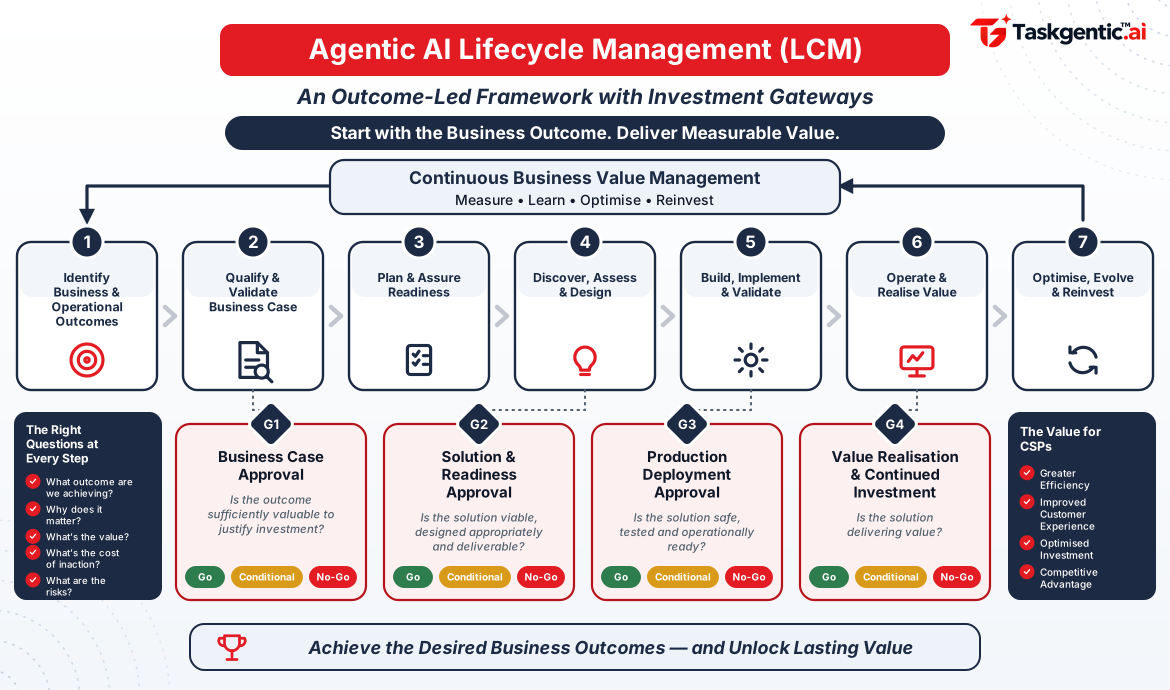 (opens the full-size diagram in a new tab)
1. Identify business and operational outcomes
Start by identifying where the organisation needs to improve and what it wants to achieve. This should be driven by business strategy, operational priorities, customer needs and measurable performance gaps.
Potential opportunities may exist across network operations, service assurance, service fulfilment, customer operations, field services, planning, workforce management and business support.
At this stage, the emphasis is on defining the outcome and understanding the problem. It is not about deciding which agents to build.
2. Qualify and validate the business case
Apply the seven questions to establish the value, cost, risks and dependencies associated with the opportunity.
The output should be a credible business case that makes the investment rationale clear, including the baseline, target outcomes, expected benefits, cost of inaction, full delivery and operating costs, key assumptions and risk-adjusted return.
This is the first formal investment decision point. An opportunity should not progress into a major delivery programme simply because it has executive interest or has performed well in an initial demonstration.
3. Plan and assure readiness
Once the business case has been approved, establish whether the organisation is ready to deliver the outcome.
This means assessing the availability and quality of data, systems, APIs, infrastructure, security controls, skills, operational processes and supplier capabilities. It also means confirming ownership, funding, resources, governance and the involvement of the business teams that will ultimately use and operate the solution.
Where gaps exist, they should be addressed or explicitly accepted before the programme moves forward.
4. Discover, assess and design
With the outcome and readiness requirements understood, determine the best way to achieve the objective.
This is where CSPs should assess the role of Agentic AI alongside process redesign, conventional automation, existing technology and changes to operating models.
The design should establish which activities agents will perform, how they will collaborate, what systems and tools they can access, what decisions they can make and where human approval or intervention is required.
It should also define how performance, risk and business value will be measured. The design should be shaped by the approved outcome, rather than allowing the capabilities of a particular AI platform to dictate the solution.
5. Build, implement and validate
Develop and integrate the solution, establish the required controls and test it against real operational scenarios.
This should include functional testing, security assessment, resilience, decision accuracy, integration performance, exception handling and the ability to operate safely within defined permissions.
Deployment should be progressive. Depending on the use case and its risk profile, agents may initially provide recommendations, then support human-approved actions, before moving to more autonomous execution where reliability and controls have been demonstrated.
The objective is not to maximise autonomy as quickly as possible. It is to establish the level of autonomy that is appropriate for the outcome, the operational context and the potential consequences of failure.
6. Operate and realise value
Once the solution is approved for production, the focus shifts to operational performance and the delivery of the original business case.
Are network incidents being reduced? Is service restoration faster? Are operating costs falling? Is customer experience improving? Is the workforce becoming more productive? Are the benefits being achieved at the scale and pace originally expected?
These questions need to be answered using operational evidence and financial measures, not simply reports showing that agents have been deployed or that automated task volumes are increasing.
Where results fall short, the organisation must be prepared to intervene, adjust the solution or reconsider the investment.
7. Optimise, evolve and reinvest
Agentic AI solutions should not be treated as finished once they enter production.
Business priorities change, network conditions evolve, customer expectations increase and new capabilities become available. Performance and value should therefore be reviewed continuously.
CSPs should use operational experience to improve agent performance, refine workflows, address emerging risks and identify further opportunities. They should also be willing to reduce autonomy, suspend activities or retire a solution if it no longer delivers sufficient value or cannot be operated safely.
Any significant expansion should be supported by an updated business case. Further investment should be earned through demonstrated results, not assumed because the initial programme has already been funded.
Investment gateways: keeping business discipline throughout the lifecycle
A seven-stage lifecycle provides structure, but structure alone does not guarantee good investment decisions. CSPs also need clear points at which progress is formally challenged and authorised.
Without these decision points, programmes can continue because they have momentum, because funding has already been committed or because teams are reluctant to question an established direction. That is particularly dangerous with Agentic AI, where early enthusiasm and successful demonstrations can create expectations that are not supported by operational evidence.
Four formal investment gateways should govern the lifecycle. Each should have an accountable business owner, clear decision criteria and an explicit decision to proceed, proceed subject to conditions, or stop and reassess.
Gateway 1: Business case approval
Position in the lifecycle: After outcome qualification and before detailed planning.
This gateway establishes whether the opportunity deserves investment.
The decision should be based on a clearly defined business or operational outcome, a credible baseline and target, the value of achieving the outcome, the cost of inaction, the full expected cost, and an assessment of risks and dependencies.
The business case should also demonstrate why the proposed approach is appropriate. It should not assume that Agentic AI is the answer simply because the opportunity has been labelled an AI initiative.
A GO decision authorises the organisation to proceed into planning and readiness. A CONDITIONAL decision allows progress only where specified assumptions or issues are resolved. A NO-GO decision means the opportunity should be rejected, redesigned or reconsidered.
Where uncertainty remains, a limited discovery exercise or proof of value may be authorised. This should be treated as a bounded investment to validate specific assumptions, not as implicit approval for full implementation.
Gateway 2: Solution and readiness approval
Position in the lifecycle: After planning, readiness assessment and solution design, before full implementation.
This gateway tests whether the organisation has a credible and deliverable solution.
The proposed design should demonstrate how it will achieve the approved outcome, how agents will interact with existing systems, what data and infrastructure are required, how security and governance will work, and how human oversight will be applied.
The organisation must also be confident that the necessary resources, skills, operational processes, suppliers and technical dependencies are in place or have realistic plans for delivery.
Importantly, the business case should be updated to reflect what has been learned during discovery and design. If the cost, complexity, delivery timeline or risk has increased materially, the original investment decision should not simply be carried forward unchanged.
A GO decision authorises full build and implementation. A CONDITIONAL decision identifies the outstanding requirements that must be met. A NO-GO decision requires the solution to be redesigned or the investment to be stopped.
Gateway 3: Production deployment approval
Position in the lifecycle: After build, integration and validation, before production deployment.
A solution that works in a development environment or controlled test does not automatically belong in a live telecommunications operation.
This gateway establishes whether the solution is safe, reliable and operationally ready for production.
Evidence should cover testing results, decision accuracy, successful execution, security, access permissions, resilience, auditability, exception handling, rollback arrangements and the effectiveness of human oversight. Operational teams must understand how the solution behaves, how incidents will be managed and how control can be restored if something goes wrong.
The permitted level of autonomy must also be explicitly approved. High-impact actions may require human authorisation, while lower-risk activities may be suitable for greater autonomy once performance has been demonstrated.
A GO decision authorises a controlled production rollout. A CONDITIONAL decision may permit a restricted deployment with defined safeguards and outstanding actions. A NO-GO decision prevents production release until the necessary issues have been resolved.
Gateway 4: Value realisation and continued investment
Position in the lifecycle: During operation and at defined value-review points.
This gateway asks the question that ultimately matters: is the solution delivering the business outcome for which it was funded?
Actual performance should be compared with the original baseline, targets and business case. The review should consider financial returns, operational improvements, customer impact, service performance, risk exposure and the ongoing cost of operating the solution.
The decision is not limited to whether the solution should remain in service. It should determine whether to continue, optimise, scale, extend the use case, increase autonomy, invest further, reduce scope or terminate the solution.
Where benefits are not being realised, there must be a willingness to challenge the assumptions and take corrective action. A solution should not continue simply because the organisation has already spent money on it.
These four gateways create accountability throughout the lifecycle. They also make clear that approval is not a one-off event. The business case should be revisited as evidence emerges, dependencies change and the organisation’s priorities evolve.
The principle is straightforward: investment should progress only when the evidence supports it, and continued investment should depend on demonstrated value.
Business value must remain visible throughout the lifecycle
One of the biggest risks in Agentic AI programmes is that the original business objective gradually disappears as attention shifts towards technical delivery.
Teams begin measuring model performance, agent response times, the number of agents deployed, the volume of tasks automated and the percentage of decisions made autonomously. These measures can be useful, but they do not prove that the business has improved.
CSPs need a connected view of performance across three levels.
- Business value measures whether the investment is delivering its intended financial and strategic outcomes. This might include operating cost reduction, revenue growth, margin improvement, customer retention, lower service penalties or improved return on network investment.
- Operational effectiveness measures whether the business processes and services are performing better. Relevant measures may include mean time to repair, incident volumes, service availability, order fulfilment time, first-time resolution, workforce productivity and customer experience.
- Agentic effectiveness measures whether the agents are performing their intended role. This includes decision accuracy, successful execution, exception rates, adherence to policies, reliability and the level of autonomy achieved safely.
These measures should be connected. Better agent performance should contribute to better operational performance, which in turn should contribute to business value.
If an agent is making decisions more quickly but the process is not improving, or if automation is increasing without reducing cost or improving service, the organisation needs to understand why.
The ultimate measure of success is not how much AI has been deployed. It is whether the investment has made the business better.
The organisational shift CSPs need to make
An outcome-led approach to Agentic AI is not simply a different way of managing technology projects. It requires a change in how business and technology leaders work together.
Business leaders must take ownership of the outcomes and remain accountable for the value expected from the investment. Technology teams must be responsible for delivering secure, reliable and effective capabilities that support those outcomes. Operations must be involved in defining requirements, validating solutions and measuring real-world performance.
Finance must challenge assumptions, validate costs and benefits, and maintain visibility of the investment case. Risk, security and compliance teams must be involved early enough to shape the solution rather than becoming late-stage approval functions.
This also means moving away from fragmented ownership, where one team defines the business problem, another develops the AI capability and a third is left to operate it. The lifecycle needs clear end-to-end accountability, supported by cross-functional decision-making.
The role of Agentic AI Lifecycle Management is to connect these responsibilities. It provides the discipline to ensure that the business objective remains visible, that the right solution is selected, that investment decisions are controlled and that actual value is measured throughout the life of the solution.
It also recognises that agents are not systems of record. They may interpret information, recommend actions and execute approved activities, but authoritative data, network configurations and business records should remain governed by the CSP’s established systems. Secure integration, permissions, policy enforcement, traceability and human oversight are essential foundations for responsible operation.
Competitive advantage will come from delivering outcomes, not deploying agents
The telecommunications industry is entering a period in which Agentic AI could reshape how networks and businesses are operated. The opportunity is significant, but so is the risk of repeating a familiar pattern: investing in technology at scale, measuring deployment progress and only later asking whether the business benefits have materialised.
CSPs have an opportunity to take a more disciplined approach from the outset.
They should start with the business outcomes that matter most. They should understand the value of achieving them and the cost of doing nothing. They should assess the full cost, risks and dependencies before committing significant investment. They should use formal gateways to challenge decisions as the solution progresses, and they should continue to measure whether the expected benefits are being delivered once it is in operation.
That is the difference between managing a portfolio of AI initiatives and managing the lifecycle of business value.
The distinction is important. Agentic AI Lifecycle Management should not be fundamentally about managing the lifecycle of AI agents. It should be about managing the lifecycle of business outcomes and value, using AI agents — alongside data, automation, process redesign, existing technology and organisational change — as the means to achieve them.
The CSPs that succeed will not necessarily be those with the largest number of agents, the most ambitious autonomy targets or the biggest AI programmes. They will be the organisations that make better investment decisions, solve the problems that matter and consistently turn technology into measurable business performance.
Business outcomes must drive investment. Investment must be justified. Technology must serve the outcome. And value must be demonstrated throughout the lifecycle.
That is how Agentic AI can move from promise to meaningful business impact in telecommunications.
About the Author
Chief AI Officer at Taskgentic.ai. Leading the development of enterprise agent architectures that combine collective intelligence, modular workflows and rigorous security guardrails for complex operational environments.
About Taskgentic.ai
Taskgentic.ai is pioneering the next generation of AI-driven task intelligence—helping enterprises move from isolated AI agents to secure, reusable and governed ensembles and assemblies that deliver measurable business outcomes.