

Powered by OPA and a Python-based Central Governance Agent
Communications Service Providers are moving towards increasingly autonomous operations, where multiple AI agents collaborate to manage networks, improve customer experience, strengthen security and optimise operational processes.
But as these environments become more autonomous, an important question emerges: how do we ensure that every agent operates within clearly defined boundaries, follows organisational policies and remains accountable for its actions?
A collection of intelligent agents is not, by itself, a governed Multi-Agent System.
CSPs need a consistent way to manage agent identity, ownership, authority, interactions, permissions and operational risk.
This is where the Taskgentic Agent Governance Framework for CSPs comes in.
The proposed framework uses Open Policy Agent (OPA) as its policy decision engine, supported by a Python-based Central Governance Agent and an integrated set of governance services. It provides a CSP-focused approach to governing autonomous and collaborative agents across the telecommunications environment.
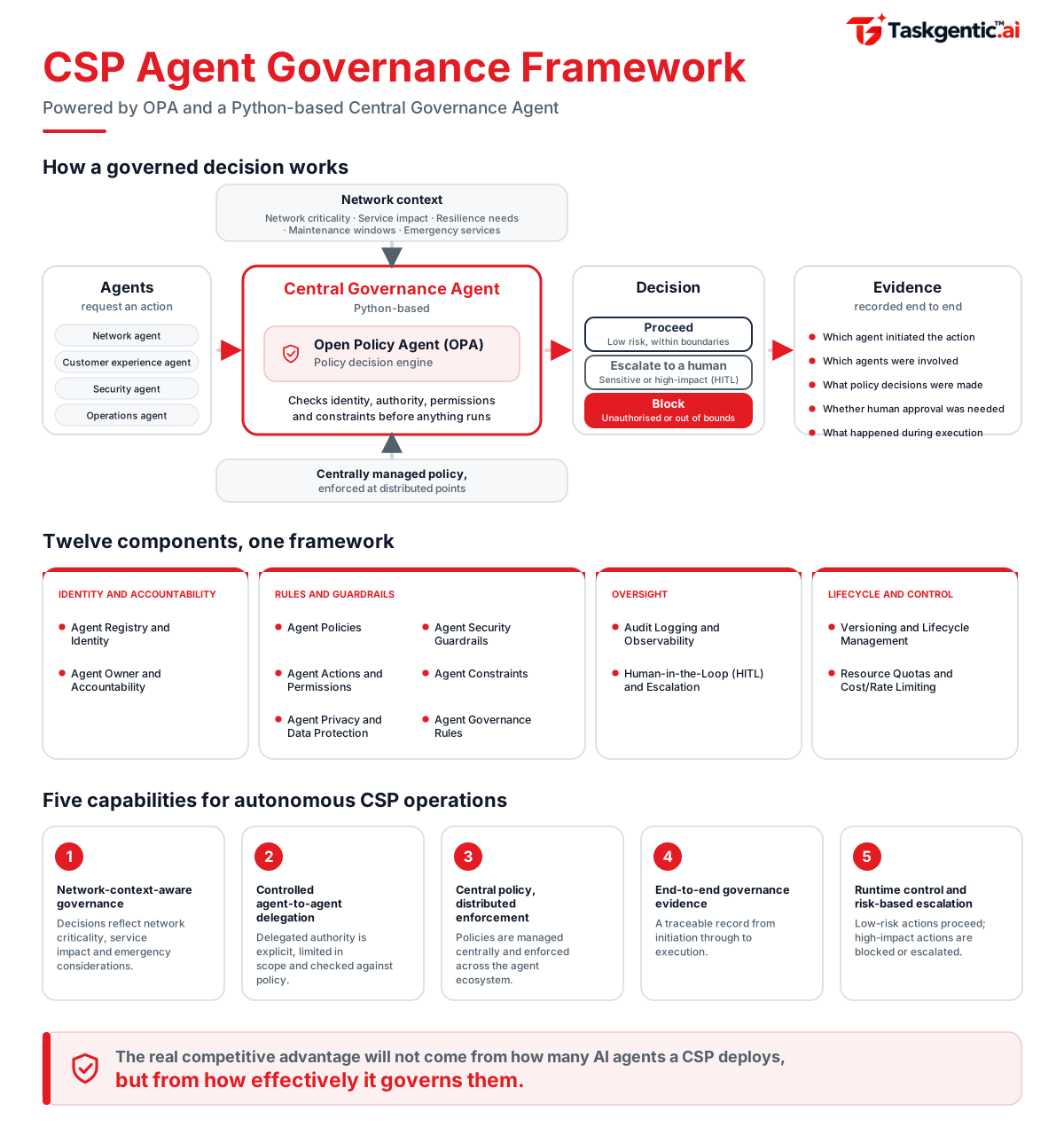 (opens the full-size diagram in a new tab)
What the framework brings together
The framework brings together the following components:
- Agent Registry and Identity
- Agent Owner and Accountability
- Agent Policies
- Agent Security Guardrails
- Agent Actions and Permissions
- Agent Constraints
- Agent Privacy and Data Protection
- Agent Governance Rules
- Audit Logging and Observability
- Human-in-the-Loop (HITL) and Escalation
- Versioning and Lifecycle Management
- Resource Quotas and Cost/Rate Limiting
Five capabilities for autonomous CSP operations
It also introduces five important capabilities that help address the specific governance challenges of autonomous operations in CSP environments:
1. Network-context-aware governance
Governance decisions can take account of operational context, including network criticality, service impact, resilience requirements, maintenance windows and emergency service considerations. An action that is acceptable in one situation may be inappropriate in another.
2. Controlled agent-to-agent delegation
Agents should not automatically inherit the full permissions of other agents. Delegated authority must be explicit, limited in scope and subject to policy checks, ensuring that an agent cannot exceed the authority granted to it.
3. Centralised policy management with distributed enforcement
CSPs can define and manage governance policies centrally while enforcing them at appropriate points across the agent ecosystem. This supports consistent governance without requiring every agent to implement its own interpretation of organisational rules.
4. End-to-end governance evidence
The framework provides a traceable record of which agent initiated an action, which agents were involved, what policy decisions were made, whether human approval was required and what happened during execution.
5. Runtime control and risk-based escalation
Agent actions can be evaluated according to their potential operational impact. Low-risk activities may proceed within approved boundaries, while sensitive or high-impact operations can be blocked or escalated for human approval.
The objective is not simply to prevent agents from doing the wrong thing. It is to give CSPs the confidence to let agents do more, while maintaining control over how they operate and collaborate.
Building on established foundations
Technologies and industry initiatives already address areas such as AI governance, policy enforcement and trusted autonomous networks. OPA itself is an established policy engine. The proposed framework builds on these foundations rather than claiming to reinvent them.
The opportunity lies in bringing these capabilities together in a telecommunications-focused governance framework, with particular attention to network context, delegated authority, runtime enforcement and operational accountability.
The framework can be demonstrated through practical scenarios, such as:
- blocking an unauthorised network configuration change
- preventing an agent from exceeding delegated permissions
- requiring human approval before a high-impact network operation proceeds
Governing at scale
Ultimately, the ambition is to help CSPs scale autonomous network operations without losing visibility, control or accountability.
The real competitive advantage will not come from how many AI agents a CSP deploys, but from how effectively it governs them.
How are CSPs approaching governance and trust as they move towards autonomous, agent-driven operations?
About the Author
Chief AI Officer at Taskgentic.ai. Leading the development of enterprise agent architectures that combine collective intelligence, modular workflows and rigorous security guardrails for complex operational environments.
About Taskgentic.ai
Taskgentic.ai is developing the next generation of AI-driven task intelligence, helping Communications Service Providers move from isolated AI agents to secure, reusable and governed ensembles and assemblies that deliver measurable business outcomes.