

Building the foundations for a trusted, coordinated and autonomous CSP enterprise
The telecommunications industry is entering another significant period of transformation. Artificial intelligence is moving beyond analytics, prediction and conversational interfaces towards systems that can reason, make decisions, coordinate activities and take action. The emergence of agentic AI has the potential to fundamentally change how Communications Service Providers (CSPs) operate, manage their networks, serve their customers and run their businesses.
The opportunity is considerable. Imagine a telecom enterprise where agents can identify a developing network issue, understand its potential impact on customers and services, coordinate the necessary teams and systems, determine an appropriate response and execute an authorised resolution. Or where customer needs, product availability, network capacity, service fulfilment and commercial considerations are brought together through coordinated intelligence rather than fragmented processes and systems.
This is the promise of the agentic enterprise: moving from the automation of individual tasks towards coordinated intelligence and action across the business.
However, realising this vision will require more than deploying agents across existing systems. It requires a coherent architectural framework that allows agents to work together, understand the business and its operational context, access enterprise capabilities securely and act within clearly defined boundaries.
For CSPs, this challenge is particularly important. Telecommunications networks are critical national infrastructure. They support businesses, public services, emergency communications and the everyday lives of billions of people. An autonomous enterprise cannot be built on intelligence alone. It must be built on trust, control, accountability and assurance.
The challenge: a fragmented approach to an enterprise-wide opportunity
Across the industry, global consultancies, specialist telecom analysts, technology providers and standards organisations are developing perspectives on agentic AI and its application to telecommunications.
These contributions are valuable. They provide important thinking around multi-agent systems, AI platforms, orchestration, enterprise transformation, autonomous networks, data architecture, governance and operational models. TM Forum’s work on Open Digital Architecture (ODA) and Autonomous Networks also provides important foundations on which the industry can build.
Yet much of the current thinking addresses individual parts of the challenge.
Some approaches concentrate on AI technology and agent platforms. Others focus on business transformation, autonomous network operations, enterprise integration or the governance of AI. There is also considerable activity around individual agent protocols, tool connectivity and interoperability.
What remains less clearly defined is how all these elements fit together into a single, coherent architectural framework for a CSP.
A CSP does not operate as a collection of independent technology domains. Its customer experience, commercial operations, service fulfilment, network operations, IT, security, finance and partner ecosystems are deeply interconnected. Decisions made in one area can have consequences across several others.
Deploying agents independently within these domains risks creating another generation of silos: intelligent systems that work well within their own boundaries but struggle to coordinate decisions and actions across the enterprise.
The industry therefore needs to move beyond isolated agent deployments and consider how to architect the agentic CSP as a connected enterprise.
Why CSPs need a unified agentic architecture framework
A unified agentic architecture framework is not about prescribing a single AI platform, model or technology supplier. Nor is it about replacing the existing investments CSPs have made in their enterprise and operational architectures.
It is about establishing a common architectural blueprint that connects these investments and provides the foundations for agents to operate as part of one coordinated enterprise.
Such a framework needs to address several fundamental questions.
- How does the CSP decide which agents are worth building, and on what business case are they approved?
- How do agents discover one another and understand what capabilities they can provide?
- How are responsibilities delegated and coordinated across business and technology domains?
- How do agents access reliable enterprise knowledge and understand the context in which they are operating?
- How are decisions governed when several agents have different objectives or recommendations?
- How can agents interact with existing OSS, BSS, IT and network systems without compromising operational integrity?
- And, perhaps most importantly, how can CSPs ensure that every action is authorised, safe, traceable and consistent with business and operational policy?
These are not simply technology integration questions. They are enterprise architecture questions.
A unified approach should bring together enterprise intent, business justification, decision-making, agent orchestration, domain capabilities, knowledge, execution, security, governance and outcome assurance into one coherent framework.
It should also recognise that the journey towards autonomy will be progressive. CSPs will need to support everything from simple advisory agents to highly autonomous systems operating within carefully defined boundaries.
Introducing the Taskgentic Agentic Enterprise Architecture Framework
To address this need, we propose the Taskgentic Agentic Enterprise Architecture Framework: a unified architectural framework designed specifically for the telecommunications industry.
Its purpose is to provide a common blueprint for building a trusted, coordinated and increasingly autonomous CSP enterprise.
The framework brings together five fundamental architectural pillars.
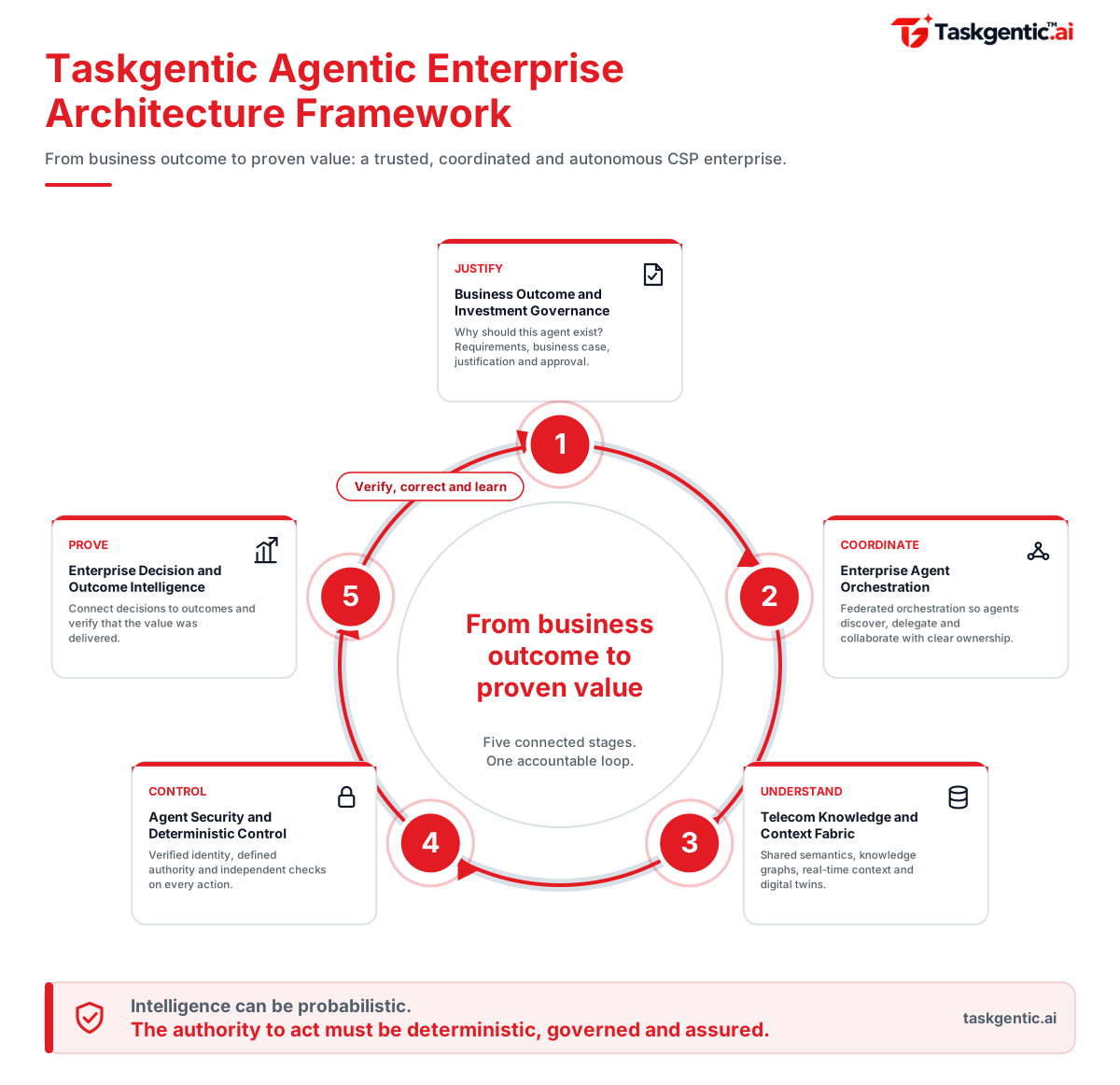 (opens the full-size diagram in a new tab)
Business Outcome and Investment Governance
The first pillar addresses a question that comes before any architecture: why should this agent exist at all?
Many agentic initiatives begin with the technology: a promising pilot, an available platform or an enthusiastic team. Only later do they ask which business outcome they serve and whether it justifies the cost. In a CSP, where agents may eventually act on live networks, customer accounts and financial transactions, that sequence is not good enough. An agent should earn its place in the enterprise before it is built, and earn it again before it is allowed to act.
Business Outcome and Investment Governance provides the structure for doing this. At the start of every agentic initiative, it establishes four things:
- Business outcomes and agentic requirements: the business or operational outcome to be achieved, with a clear baseline and target; the decisions the agent will take; the systems, data and tools it will need; and the level of autonomy it requires.
- Business case: the value of achieving the outcome; the full cost of delivering and operating it, including data remediation, integration with OSS and BSS, security and the ongoing cost of running AI; the risks and dependencies; and the cost of doing nothing.
- Business justification: whether Agentic AI is the right way to achieve the outcome at all. Process redesign, conventional automation or better data may deliver the result more effectively, and where they do, they should be the preferred option.
- Approval: an accountable decision, taken by a named business owner against explicit criteria, to proceed, proceed subject to conditions, or stop.
Approval is not a single event. The framework applies formal investment gateways at the points where commitment and risk increase: before detailed planning, before full implementation, before production deployment, and at defined value reviews once the agent is operating. The level of autonomy an agent is granted is part of what is approved. Any move towards greater autonomy, a wider scope or a new domain should trigger a fresh decision and an updated business case.
This pillar connects directly to the other four. The outcomes and requirements it approves become the objectives that orchestration coordinates, the context the knowledge fabric must provide and the boundaries that deterministic control must enforce. They also become the baseline against which Enterprise Decision and Outcome Intelligence, the final pillar, measures whether value has been delivered. Together, the first and last pillars close the loop: the first decides what is worth doing and on what terms, and the last verifies that it delivered.
Just as the authority to act must be deterministic, governed and assured, so must the authority to invest.
For CSP leadership, the practical effect is accountability. Business owners remain responsible for the outcomes they sponsor. Finance can challenge assumptions and validate costs and benefits. Risk, security and compliance teams help shape the solution early, instead of approving it at the end.
Enterprise Agent Orchestration
The second pillar provides the ability to coordinate agents across the enterprise. Rather than allowing individual agents to operate independently, it establishes a federated approach in which enterprise-level orchestration works with domain-level orchestrators and specialist agents.
This allows business objectives to be translated into coordinated activities across customer, commercial, service, network and IT domains. Agents can discover capabilities, delegate responsibilities, collaborate on complex tasks and coordinate their actions while maintaining clear ownership and accountability.
The objective is not to create one central agent controlling everything. It is to enable distributed intelligence with enterprise-wide coordination.
Telecom Knowledge and Context Fabric
Agents can only make meaningful decisions when they understand the environment in which they operate.
Telecommunications businesses contain vast amounts of information distributed across network inventories, service platforms, customer systems, product catalogues, operational processes, policies and enterprise knowledge repositories. Much of this information is fragmented, inconsistent or difficult to interpret across organisational and technology boundaries.
The Knowledge and Context Fabric provides a common foundation through which agents can access and understand enterprise information. It brings together shared semantics, knowledge graphs, real-time operational context, digital twins and relevant historical experience.
This is particularly important in telecommunications, where understanding the relationships between customers, products, services, resources and networks is essential to making sound decisions.
Agent Security and Deterministic Control
Perhaps the most important distinction between a generic agentic enterprise architecture and one designed for telecommunications is the treatment of security, authority and operational control.
Agentic systems are inherently probabilistic. They can reason, interpret information and develop plans, but their outputs are not guaranteed to be correct or safe. An agent may misunderstand a situation, act on inaccurate information, be manipulated through malicious inputs or propose an action with consequences it has not fully understood.
In a CSP environment, the consequences could extend well beyond an incorrect answer. They could affect network availability, customer services, sensitive data, financial transactions or critical infrastructure.
For this reason, deterministic control must be a mandatory architectural requirement for every agent entering CSP production.
The principle is straightforward: agents may reason, recommend and propose actions, but independent deterministic controls must govern what they are permitted to execute.
Every agent must have a verified identity, clearly defined authority and access to only the capabilities it is authorised to use. Proposed actions must be evaluated against security requirements, operational policies, business rules, safety constraints and the current operating environment.
The level of control should reflect the risk involved. An agent retrieving information does not require the same execution restrictions as one changing a live network configuration. However, neither should be exempt from the framework’s mandatory security, identity, governance and assurance requirements.
Crucially, risk must be assessed not only when an agent is introduced but also when it proposes an action. A change that is acceptable under normal network conditions may become unsafe during a major incident or when critical services are affected.
This separation of probabilistic intelligence from deterministic control is fundamental to establishing trust in the agentic CSP.
Enterprise Decision and Outcome Intelligence
The fifth pillar ensures that agentic activity remains connected to enterprise objectives and measurable business outcomes.
Without this connection, CSPs risk deploying large numbers of agents that automate tasks but do not necessarily improve the performance of the business.
Enterprise Decision and Outcome Intelligence provides the mechanisms to translate strategic and operational objectives into decisions, priorities and measurable outcomes. It helps coordinate competing objectives, understand dependencies, evaluate trade-offs and determine whether the actions taken have delivered the intended results.
It also closes the loop between decision and execution. The enterprise must be able to verify what happened, understand whether the expected outcome was achieved and take corrective action when it was not.
Ultimately, the value of an agentic enterprise should be measured not by the number of agents deployed, but by improvements in customer experience, service quality, network performance, operational efficiency, resilience and commercial performance.
Bringing the framework together
These five pillars provide the conceptual foundation, but they must operate within a broader enterprise architecture.
The framework connects them through a set of architectural layers spanning enterprise intent and experience, decision intelligence, agent orchestration, domain agents, knowledge and context, capability discovery, execution, AI runtime, agent lifecycle management and outcome assurance.
These layers are supported by common enterprise control capabilities covering identity and trust, policy and governance, security and privacy, observability and audit, and human oversight.
The framework is intended to span the full CSP value chain. This includes customer and experience management, product and commercial operations, sales and revenue, service fulfilment, network operations, IT and cloud, enterprise functions, security and risk, partners and wholesale, and enterprise strategy.
Importantly, the framework is designed to work with existing CSP architecture investments rather than replace them.
TM Forum ODA, Autonomous Networks, AI-Native ODA and existing OSS and BSS architectures provide valuable foundations. The framework seeks to connect these capabilities into a wider agentic enterprise blueprint, providing the coordination, knowledge, control and assurance needed to operate across organisational and technology boundaries.
It should therefore be viewed as a unifying architectural framework, not another competing technology stack.
Autonomy must be earned through trust
A critical consideration for CSPs is that autonomy cannot be treated as a simple technology deployment objective.
An agent that can independently perform a task is not necessarily an agent that should be allowed to do so in production.
The journey towards an autonomous enterprise must be governed by the level of trust that can be established in the agent, its operating environment and the controls surrounding it.
Some agents will remain informational or advisory. Others will be permitted to execute bounded and reversible actions. More advanced agents may eventually coordinate complex activities across multiple domains, provided their authority, operational boundaries and safety controls have been independently established.
This requires a progressive approach to autonomy, supported by evidence of reliability, security, control effectiveness and measurable outcomes.
Human oversight will remain important, particularly for high-impact, ambiguous or irreversible decisions. However, human approval alone cannot be the primary safety mechanism for an enterprise operating at machine speed and scale. Deterministic controls must provide continuous protection, with human intervention applied where the assessed risk and circumstances require it.
Trust must be engineered into the framework, not assumed from the intelligence of the agents.
A collective opportunity for the telecom industry
The telecommunications industry has an opportunity to shape how agentic enterprises are architected and operated in one of the world’s most demanding and consequential industries.
Rather than allowing individual CSPs and suppliers to develop disconnected approaches, there is an opportunity to establish a shared architectural reference that encourages consistency, interoperability, security and responsible autonomy.
This does not mean standardising every implementation detail or restricting innovation. CSPs should retain the freedom to choose their AI models, platforms, agents and technology partners. What the industry needs is agreement on the architectural principles, capabilities, interaction contracts, control requirements and assurance mechanisms that allow these different components to work together safely.
Such a framework could provide a common reference for CSP enterprise architects, technology providers, systems integrators, standards organisations and industry bodies.
It could also provide a practical foundation for collaboration with TM Forum and the wider telecom ecosystem, building on existing standards and architectural work rather than duplicating it.
From agent deployments to the agentic CSP
The transition to an agentic enterprise will not happen overnight. It will evolve through experimentation, targeted deployments, integration and increasing levels of autonomy.
But the architectural decisions made today will determine whether those deployments become a collection of disconnected AI capabilities or the foundation of a genuinely coordinated and intelligent enterprise.
The opportunity is to move beyond simply introducing agents into existing processes and instead rethink how the CSP operates as an interconnected system of intelligence, decisions and actions.
The Taskgentic Agentic Enterprise Architecture Framework provides a way to approach this transformation: bringing together business outcome and investment governance, enterprise orchestration, telecom knowledge and context, deterministic security and control, and outcome-driven decision intelligence.
Above all, it recognises a principle that must underpin the future of telecommunications: intelligence can be probabilistic, but the authority to act must be deterministic, governed and assured.
That is the foundation on which a trusted, coordinated and truly autonomous CSP enterprise can be built.
About the Author
Chief AI Officer at Taskgentic.ai. Leading the development of enterprise agent architectures that combine collective intelligence, modular workflows and rigorous security guardrails for complex operational environments.
About Taskgentic.ai
Taskgentic.ai is developing the next generation of AI-driven task intelligence, helping Communications Service Providers move from isolated AI agents to secure, reusable and governed ensembles and assemblies that deliver measurable business outcomes.